December 15, 2025
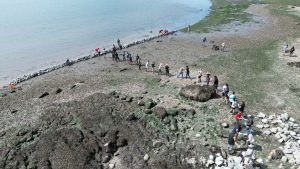
Many helping hands lay the foundation for the Swinomish Tribe’s clam garden in August 2022.
In August 2022, the Swinomish Indian Tribal Community laid the foundational rocks of what would become the first modern-day clam garden in the United States. This revival of an ancient Indigenous mariculture practice can boost clam production and species diversity, enhance food sovereignty, increase resilience, and also provide a cultural space for community knowledge sharing and connection.
Before those first stones were set, the Tribe had engaged in years of planning and preparation. This included the work of researchers from the Tribe and Washington Sea Grant to develop a model to choose a clam garden site considered optimal for the ecosystem while at the same time, maximizing socio-cultural benefits to the Swinomish Tribe. That collaborative research process has now been published in the Journal of Integrative Environmental Sciences, providing a real-world example of how to effectively and meaningfully weave together multiple research disciplines and ways of knowing to guide decisions affecting resource management and community health concerns.
The researchers took a noteworthy approach to this work, defined by a recognition of the interconnectedness of the natural world and community well-being, and an understanding of the importance of centering community priorities in their process. “Our beaches hold our history and memories of taking care of the clams and other relatives of the sea, they are places where we share important teachings when the community is present,” said Joe Williams, Swinomish shellfish community liaison and one of the study’s authors.
Location is key to the success of any fisheries management or conservation action “Selecting a site that is both suitable ecologically for naturally growing clams and is supported and maintained by the community is essential to the future success of the clam garden,” said Courtney Greiner, lead author and marine ecologist for the Swinomish Indian Tribal Community’s Fisheries Department. “The need for an integrated social-ecological site decision was particularly true for Swinomish’s clam garden project where the intent has been to foster and strengthen a living relationship between the people of a place-based Indigenous community and intertidal clams in their area for generations to come. This involves a series of iterative steps,” added Melissa Poe, social scientist at Washington Sea Grant and one of the authors.
The researchers created a technical advisory group, which included members of the established Clam Garden Network, First Nations experts who have been involved in clam garden restoration projects, professional researchers and academia, and Tribal Elders and Swinomish Tribal leadership.
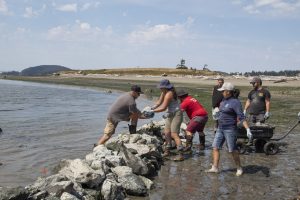
Building the clam garden wall.
The researchers then began narrowing in on a site for the clam garden by developing an initial site exclusion map that used environmental and socio-cultural criteria to delineate tideland areas that would be suitable and unsuitable for a clam garden.
The sites were also evaluated based on the presence of protected eelgrass beds. After analyzing the sites based on those ecological factors, the researchers narrowed the list of potential sites to three.
From there, the research team’s social scientists created a survey for members of the Swinomish Tribe to identify their priorities for a clam garden and to evaluate each of the three final candidate sites based on their likelihood to achieve a range of socio-cultural benefits. Fifty-five Tribal members completed the survey.
According to the survey, ceremonial and subsistence harvests were identified as the highest priorities for the clam garden, followed closely by teaching. A majority of the survey participants selected the same site as being the most important location for a future clam garden overall. Thanks to this in-depth, collaborative process that guided decisions, this is where the Swinomish Tribe’s clam garden exists today.
As part of their learning process, the researchers reflected on how revitalizing a biocultural practice such as clam gardens also involves reawakening the stories tied to those practices. One such story about the importance of the relationship between clams and people came from the late Swinomish Elder Wanaseah Larry Campbell. “The clams cared for the people, and the people cared for the clams. When the people were no longer able to access a beach where their ancestors had gone since time immemorial, the clams cried for the people, asking them to return.”
And now, the people have.
The researchers dedicate their work to two of the study’s co-authors, Swinomish Elders and leaders ?itǝkwbixw Lorraine Loomis and Wanaseah Larry Campbell, who each walked on from this life in August 2021 and February 2023 respectively.
###
Washington Sea Grant, based at the University of Washington, helps people and marine life thrive through research, technical expertise and education supporting the responsible use and conservation of coastal ecosystems. Washington Sea Grant is one of 34 Sea Grant programs supported by the National Oceanic and Atmospheric Administration in coastal and Great Lakes states that encourage the wise stewardship of our marine resources through research, education, outreach and technology transfer.
Join the conversation: instagram.com/waseagrant and Facebook.com/WaSeaGrant.
DEC
2025