March 31, 2026
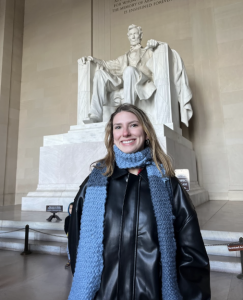
My name is Seiler Grubb, I usually go by Sei, and I am very excited to work with Washington Sea Grant as an undergraduate science communication fellow for the spring of 2025. I grew up in Kansas City, Missouri and always loved traveling to the coasts so I could be near an ocean. Fortunately, I got the opportunity to move to California in the fall of 2022. Shortly after, I worked with students at The University of California, Berkeley and helped write and collect data for a paper exploring communication behavior in elephant seal pups. I enjoyed researching and observing marine mammals, and knew I wanted to get involved in the environmental field.
The following year, I officially moved to Seattle to start my undergraduate degree with The University of Washington (UW). I originally came to UW to study Marine Biology but shortly realized that I had a love for communication and environmental policy. I changed my major to Environmental Studies and was able to combine my interest in marine biology with policy and research. In the spring of my sophomore year, I got involved with the Acidification Nearshore Monitoring Network (ANeMoNe) as a field volunteer. ANeMoNe is a volunteer program that uses volunteer data to monitor changing water conditions, as well as species health. As a volunteer, I observed and recorded bird behaviors, measured eelgrass coverage, and checked water pH, at varying sites around Elliott Bay.
I enjoyed field work so much that, in the months that followed, I started as an intern for Shilshole Light Trap Sampling led by Professor Sean McDonald. With Shilshole, fellow interns and I measured the number of dungeness crab megalopae in 20+ sites around the Puget Sound and collected water condition indicators such as pH and temperature. The long term goal of shilshole is to better understand population fluctuations of dungeness crabs as well as possible environmental impacts on the species.
At the start of the summer of my sophomore year, I officially began as an intern with the Coastal Observation and Seabird Survey Team (COASST). Since starting with COASST, I have been chosen as a senior intern and AmeriCorps staff, and will maintain my position until June of 2026. Being an intern at COASST introduced me to working with citizen science networks and volunteers from around the west coast. I work with hundreds of volunteers to collect data on beached birds so long term population variation can be investigated. I wanted to get more involved in volunteer engagement and was able to successfully create several outreach programs.
I am very grateful that I have been given the opportunity to work with Washington Sea Grant, as I am able to be a part of environmental outreach and communication initiatives, as well as explore research regarding the Puget Sound.
###
Washington Sea Grant, based at the University of Washington, helps people and marine life thrive through research, technical expertise and education supporting the responsible use and conservation of coastal ecosystems. Washington Sea Grant is one of 34 Sea Grant programs supported by the National Oceanic and Atmospheric Administration in coastal and Great Lakes states that encourage the wise stewardship of our marine resources through research, education, outreach and technology transfer.
Join the conversation: instagram.com/waseagrant and Facebook.com/WaSeaGrant.
MAR
2026