January 5, 2026
Last year continued Washington’s trend of increasing green crab activity, both in the number of crabs trapped and in the growing network of people working to find and remove them. In early December, Washington Sea Grant (WSG) brought together trappers from across the state to compare notes from the 2025 season – our biggest Trappers’ Summit to date! We’re sharing highlights from those conversations in two annual summary posts. This post focuses on the Salish Sea; a companion post will cover Pacific coast estuaries.
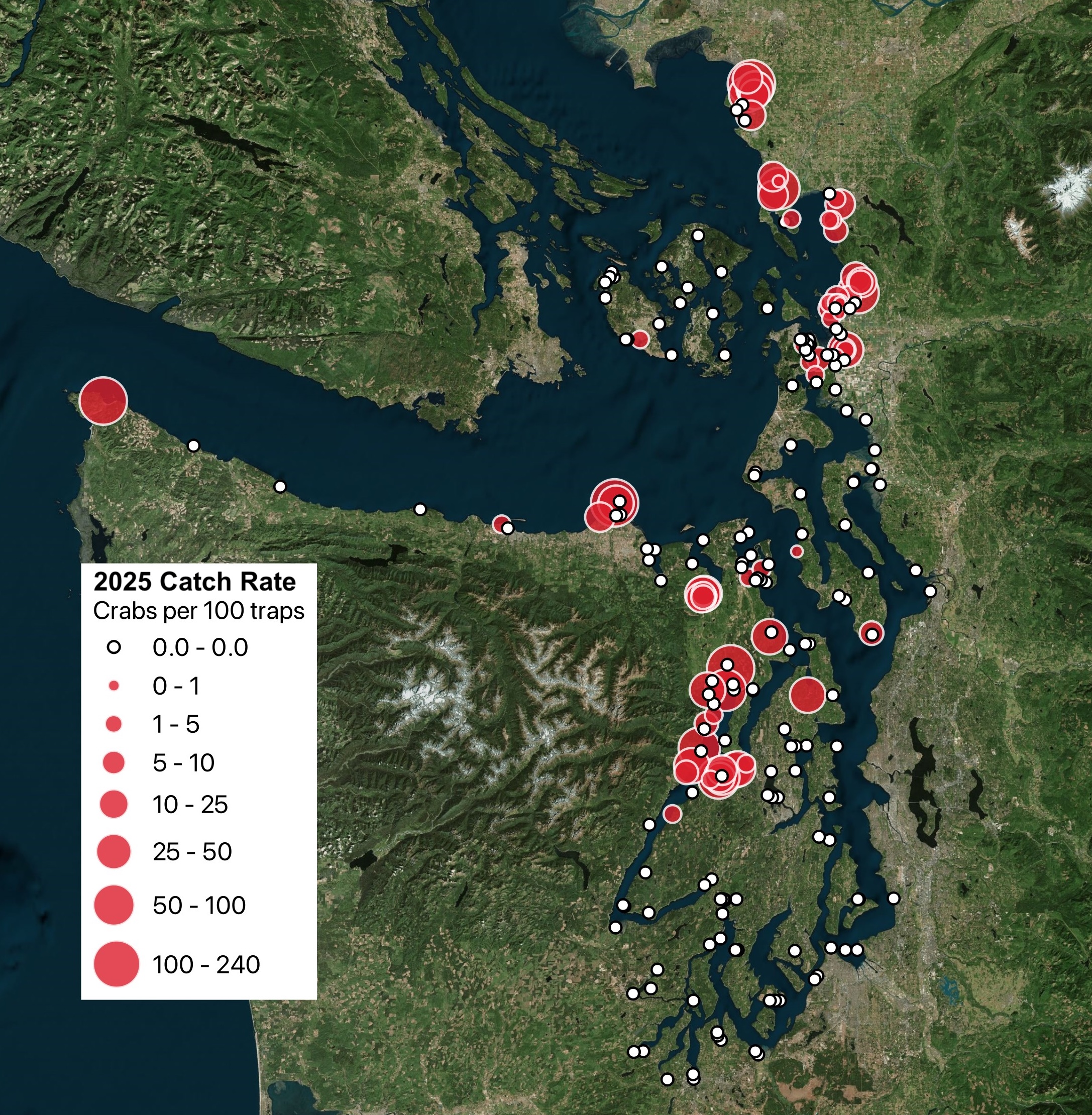
Map of 2025 annual average catch rate, number of crabs captured per 100 trap sets. Note that this figure shows only data from trapping effort and does not include molts, dead, or hand captured crabs. Notably, the single crab captured in Possession Sound in 2025 by Tulalip Tribes does not appear on this figure. Click to enlarge
Across the Salish Sea, several clear signals point to population growth and continued spread of green crab populations. In 2025, annual catch rates (average crabs per 100 traps), a rough indicator of abundance, increased at nearly half of monitored sites compared to 2024. Nearly every Salish Sea site recorded its highest early-season catch rates on record (April–May). Most of these crabs came from the strong 2024 year class—leftovers from an exceptionally successful recruitment linked to El Niño conditions the previous winter. That carryover showed up even at sites where late-2024 recruitment appeared weak. In contrast, recruitment of the 2025 cohort was uneven, with a strong pulse in North Puget Sound but little activity elsewhere.
New detections also pushed the known green crab footprint outward—farther into Hood Canal, and into Whidbey Basin for the first time – and into several areas between sites green crabs had previously been detected.
Despite these concerning trends, there’s good news too. Many more new sites are trapped each year, and in 2025 the vast majority of this exploration showed no sign of green crabs. A special shout-out goes to trapping groups in South Puget Sound, who coordinated another large-scale effort that—thankfully—resulted in zero detections. Finally, at most sites where green crabs have historically been present at low numbers, catch rates remain extremely low, likely reflecting both the growing and sustained effort by trappers throughout the Salish Sea.
North Puget Sound
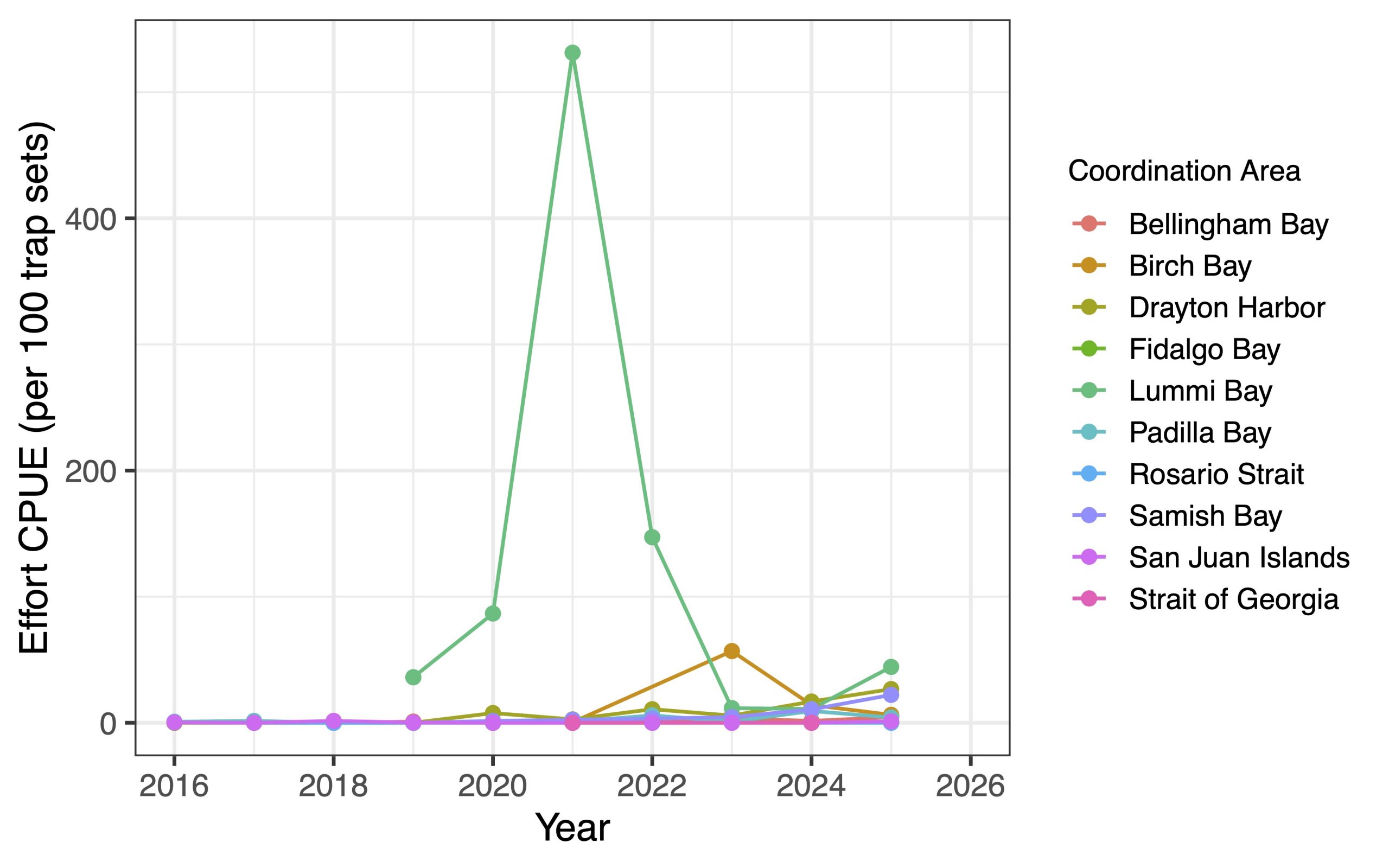
Average annual catch rate of green crabs at sites across the north Puget Sound region. Click to enlarge.
- Changes across North Puget Sound were mixed in 2025. Catch rates increased at some sites and declined at others, with the clearest increases at sites that already supported larger populations, including Drayton Harbor, Samish Bay, and Lummi Bay.
- Late summer and early fall brought evidence of very strong recruitment in Whatcom and Skagit Counties. This was surprising, as 2025 lacked the El Niño conditions often linked to high recruitment. Yet this region also experienced high recruitment in 2022—another non–El Niño year—raising new questions about what local conditions may be driving these pulses.
- Green crabs were detected in the San Juan Islands for the first time since 2019, including a new site in False Bay. Follow-up trapping found low numbers and low catch rates, with all crabs belonging to the 2024 year class. These isolated finds may point to a recent dispersal event rather than an established population.
- Although catch rates increased in Lummi Bay relative to 2024, they remain nearly 90% lower than the site’s peak in 2021.
Central Puget Sound
- Central Puget Sound remains the southern edge of confirmed green crab presence in the Salish Sea, and numbers here are still very low. As of 2025, Cultus Bay is still the southernmost site with confirmed adult green crabs, following the first detection there in 2024. Two green crabs were captured at Cultus Bay in 2025.
- Two first-ever detections occurred within the Whidbey Basin—Possession Sound and Skagit Bay. The ages of the crabs at both sites, along with the lack of detections between them, suggest green crabs likely entered the basin from either end – rather than sweeping from north to south. The Skagit River outflow may be acting as a partial barrier to movement within the basin.
Hood Canal
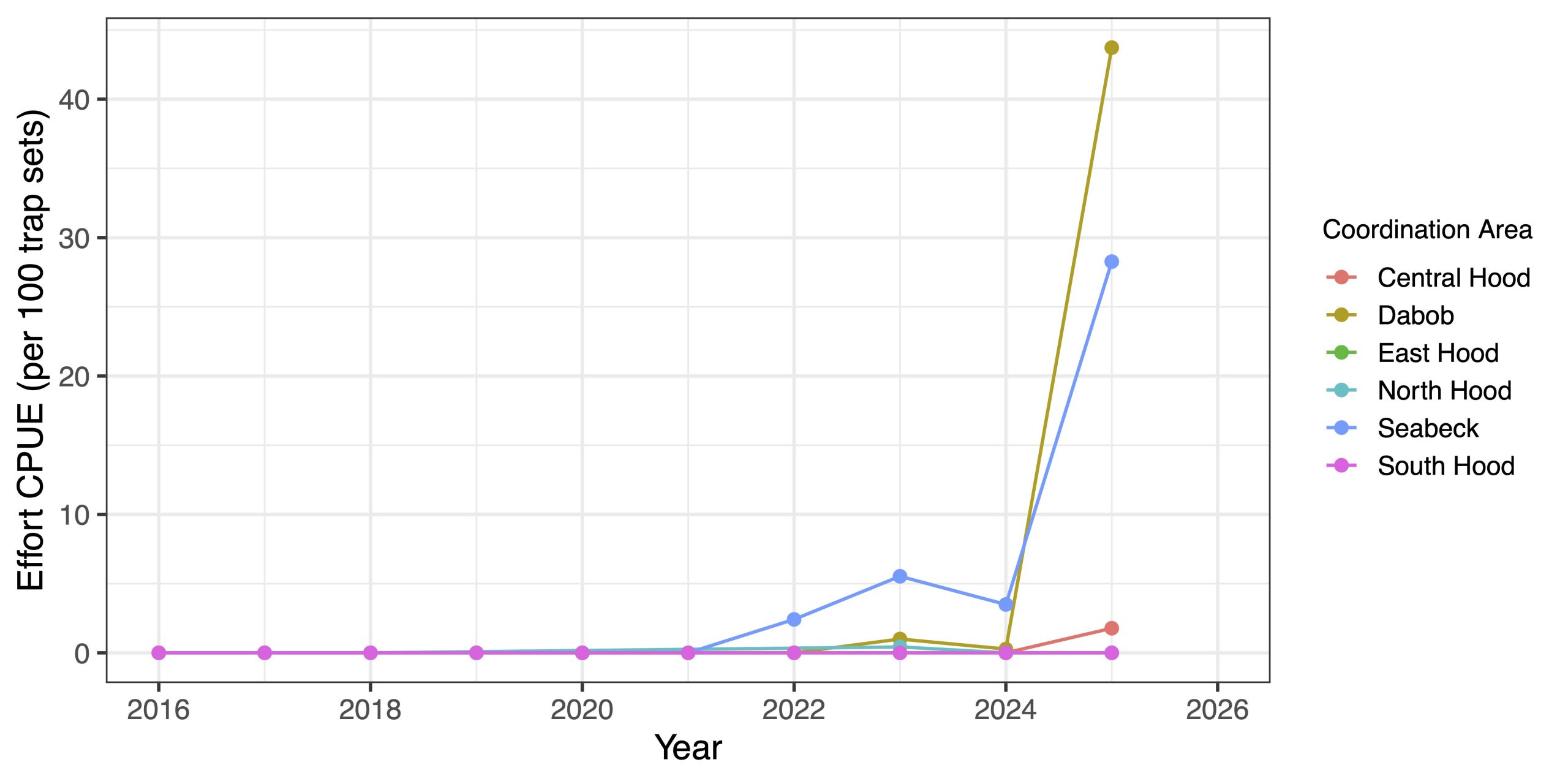
Average annual catch rate of green crabs at sites within Hood Canal. Click to enlarge.
- Hood Canal saw some of the most dramatic changes in the Salish Sea in 2025. Catch rates climbed sharply at sites where green crabs were already present, and first-time detections occurred at more than a dozen new locations, including Port Gamble Bay, Port Ludlow, and Anderson Cove. While Port Gamble Bay and Port Ludlow fall between known sites from previous years, Anderson Cove marks a significant expansion deeper into Hood Canal than documented to date.
- Many of the crabs captured in Hood Canal were one year old, originating from the 2024 cohort. This was unexpected, given the limited evidence of recruitment at the end of the 2024 season. Recruitment of the 2025 cohort appeared weaker than in North Puget Sound, though past patterns suggest some cohorts don’t show up in traps until the following spring. Trappers will be watching closely in early 2026.
Strait of Juan de Fuca
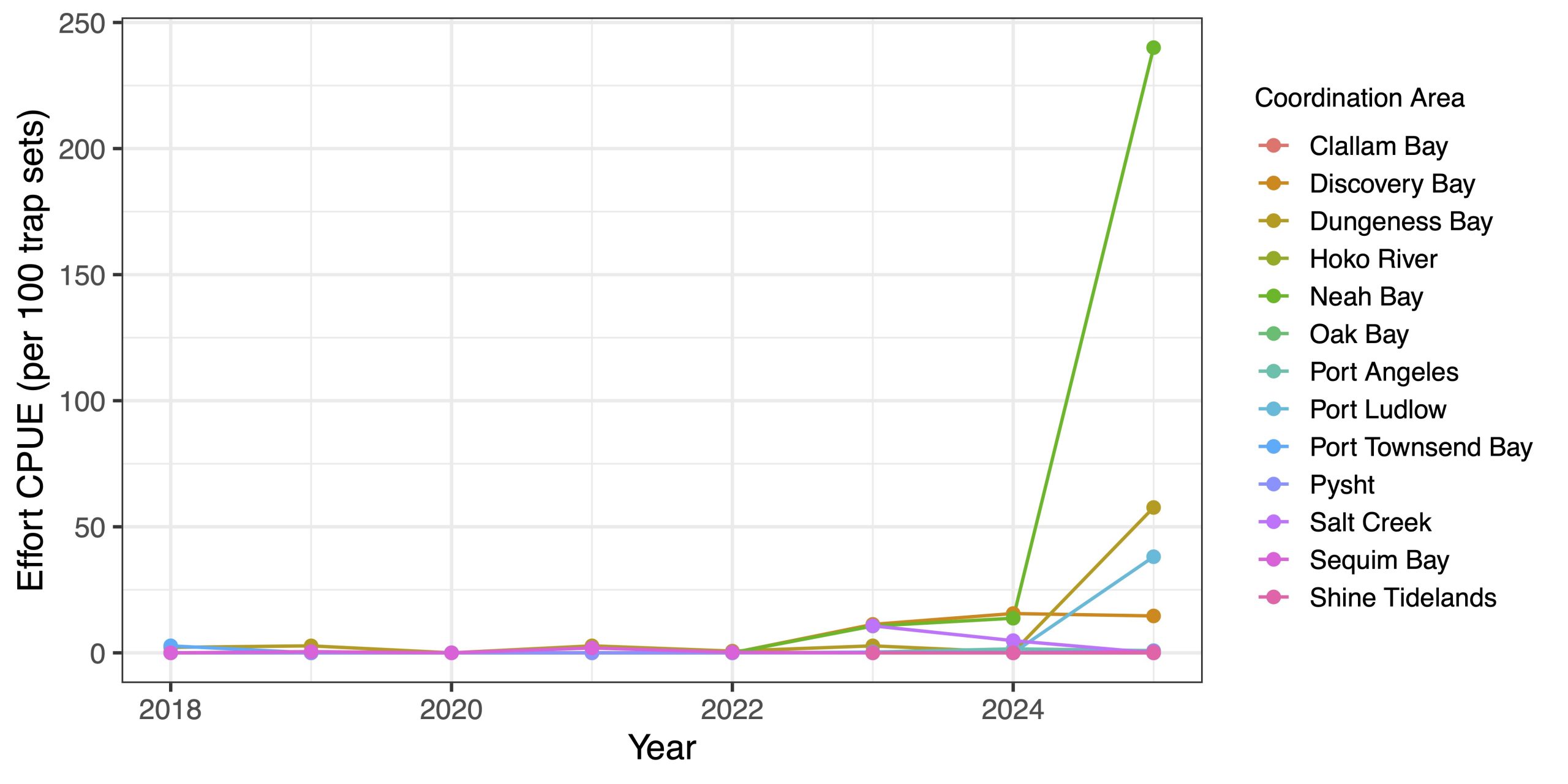
Average annual catch rate of green crabs at sites across the Strait of Juan de Fuca and Admiralty Inlet. Click to enlarge
- Within the Strait of Juan de Fuca, Neah Bay and Dungeness Bay stood out for large increases in catch rates in 2025. Although yearly averages were higher than in 2024, catch rates at both sites peaked in late spring or early summer and declined as the season progressed.
- The Makah Tribe first documented notable green crab numbers in Neah Bay in 2024. In 2025, catch rates increased nearly tenfold. Large numbers of young crabs were observed in late spring—a pattern more typical of Pacific coast estuaries (such as Makah Bay, Willapa Bay, and Grays Harbor) than of most Salish Sea sites, where recruitment is usually detected later in the summer.
- Dungeness Bay showed a pattern similar to Hood Canal, with much of 2025’s increase driven by 2024-cohort crabs that weren’t detected until spring. As elsewhere, relatively few 2025-cohort crabs were captured late in the season.
- In Discovery Bay, sustained high trapping effort resulted in catch rates comparable to those observed in 2024.
Looking ahead
While green crab populations continue to spread and grow in some areas, the 2025 season also highlighted the power of early detection, sustained effort, and strong coordination. Many newly trapped sites remained crab-free, long-managed sites stayed low, and trapping capacity across the Salish Sea continues to expand.
Next we will summarize observations and changes from Washington’s Coastal estuaries in 2025 – stay tuned!
Partner data contributed by: Washington Department of Fish & Wildlife, Northwest Straits Commission, Washington Department of Natural Resources, Padilla Bay NERR, US Fish and Wildlife Service, the Suquamish, Squaxin, Lower Elwha, Jamestown, Port Gamble S’Klallam, Lummi Nation, Swinomish, Stillaguamish, Makah, Samish, and Tulalip Tribes, Taylor Shellfish, Drayton Harbor Oysters, Rocky Point Oysters and more than 300 monitors with WSG Crab Team!
For additional information, visit the WDFW Green Crab Hub
–Emily Grason
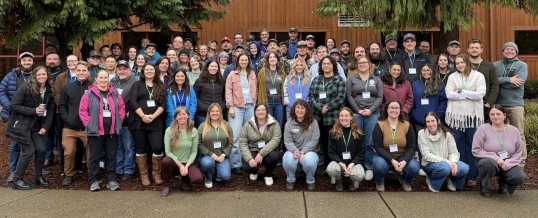
Header image: 71 trappers from 26 partner organizations across Washington Shorelines gathered in Shelton at Little Creek Casino Resort in December 2025 for the annual Trappers’ Summit. WSG hosts this workshop each year to enable technical staff to collectively discuss findings from the year and needs moving forward. Photo: K. Litle/WSG
JAN
2026