January 26, 2026
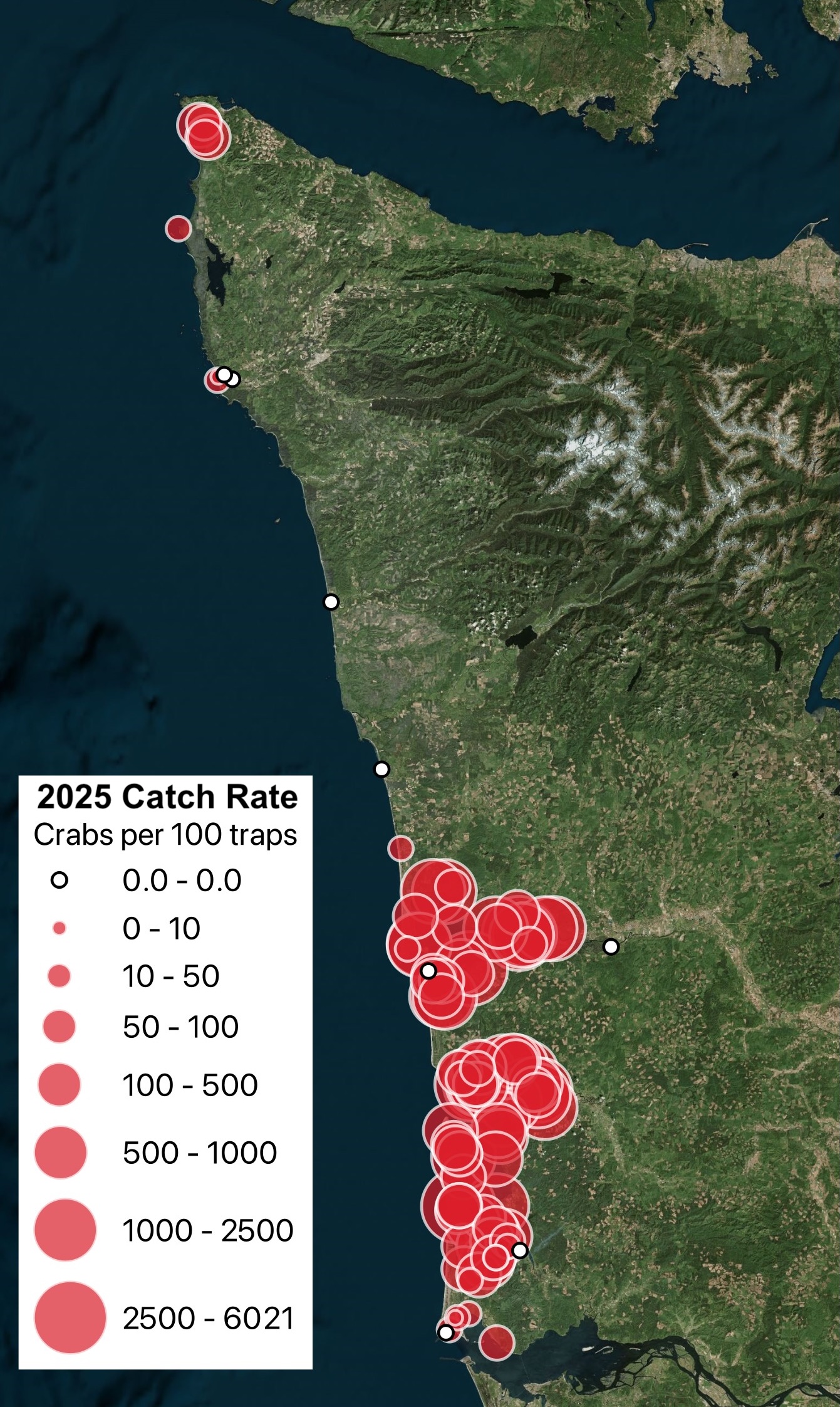
Map of 2025 annual average catch rate, number of crabs captured per 100 trap sets. Note that this figure shows only data from trapping effort and does not include molts, dead, or hand captured crabs. Click to Enlarge
Washington’s Pacific coast has a different European green crab history than the Salish Sea and faces different conditions, so here we share a summary of 2025 green crab status and trends focused on sites within coastal estuaries. This summary is based on data collected by all trapping groups working in this geography (see the footer for a list).
Where they are found in Washington green crabs are roughly 10 times more abundant at coastal sites than at sites within the Salish Sea – and they are also more widespread across shorelines. There are very few places in the estuaries along the Pacific coast where trappers look for evidence of green crabs but fail to find it. Most of those apparently “green crab free” sites have too much, or too intense, fresh water input from rivers for native crabs as well. Some examples include upstream on the Quileute, Chehalis, and Naselle Rivers, or at the mouth of the Queets and Moclips. A few smaller estuaries, like those of the Quileute and Copalis Rivers, do have the goldilocks combination – fresh enough to be protected from large native crabs, but still salty at least enough of the time for green crabs to survive.
Young-of-the-year crabs are rarely trapped at Salish Sea sites before August. In coastal estuaries, however, young crabs demonstrate different seasonal timing, with two possible peaks (once in late spring to early summer, and again in late summer to early fall) instead of one. Notably, the dominance of an early season vs. a late season peak differs across different regions of the coast.
Here are some more detailed observations from 2025 by coastal region.
Columbia River
Trapping within the Columbia River has been limited, but Washington Department of Fish and Wildlife (WDFW) has sampled some sites each year since 2021. Green crab abundances in regions up-estuary (farther east) have increased more, and to greater densities, than sites close to Cape Disappointment, at the mouth of the river. How far upstream green crabs are living in the Columbia River is still unknown.
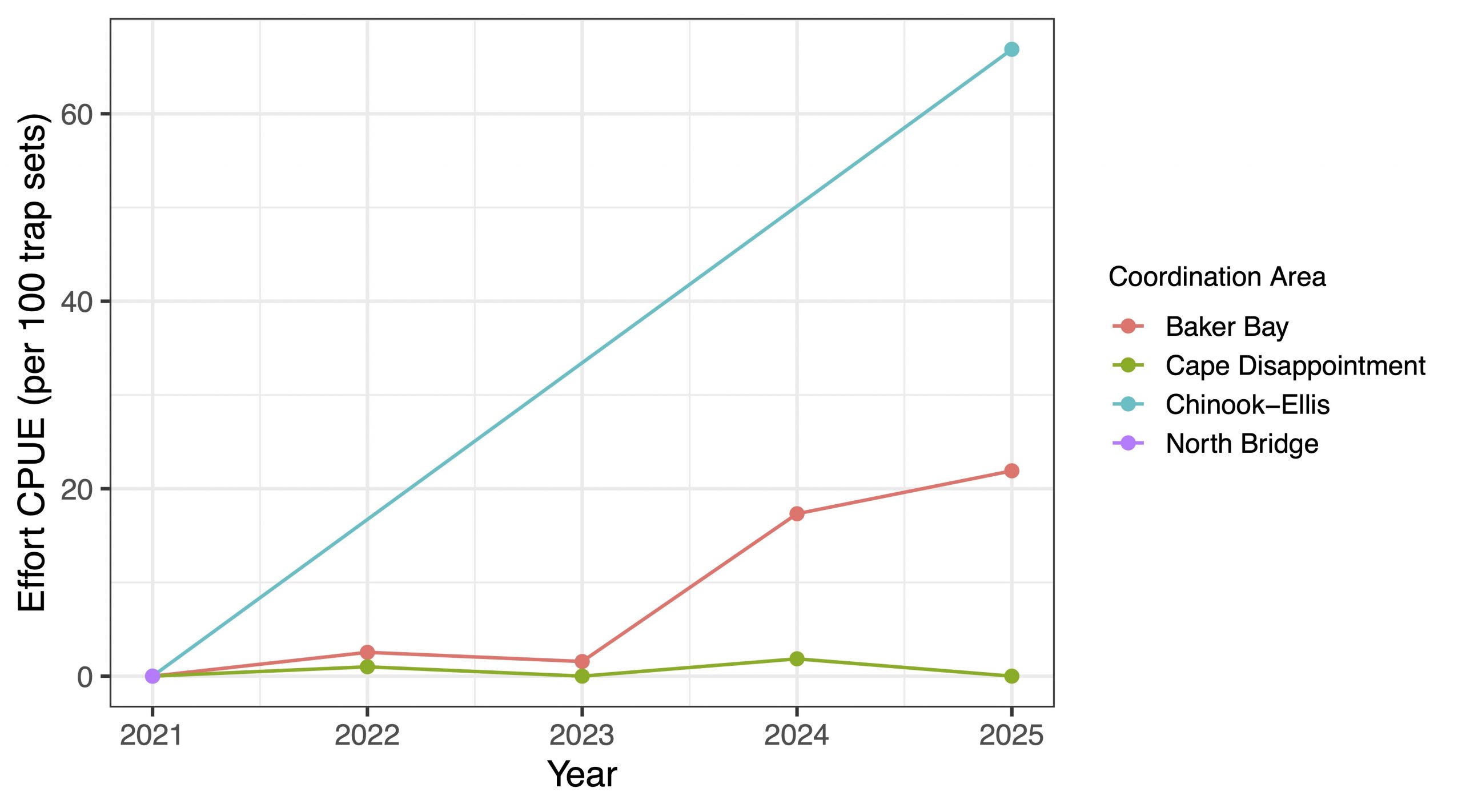
Average annual catch rate of green crabs at sites across the Columbia River management area. Click to enlarge.
Willapa Bay
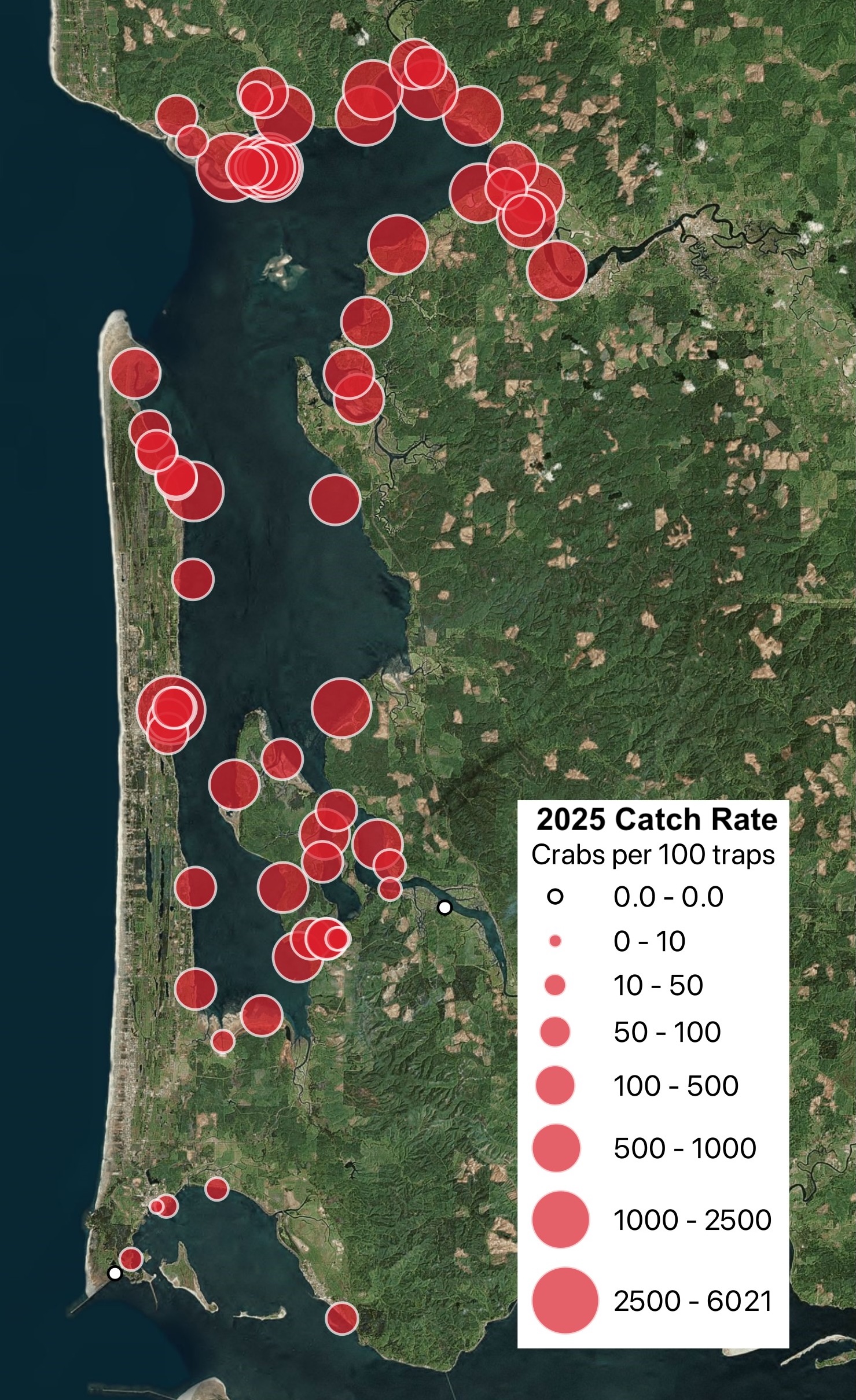
A zoomed in map showing green crab catch rate and trapping locations in Willapa Bay. Click to enlarge
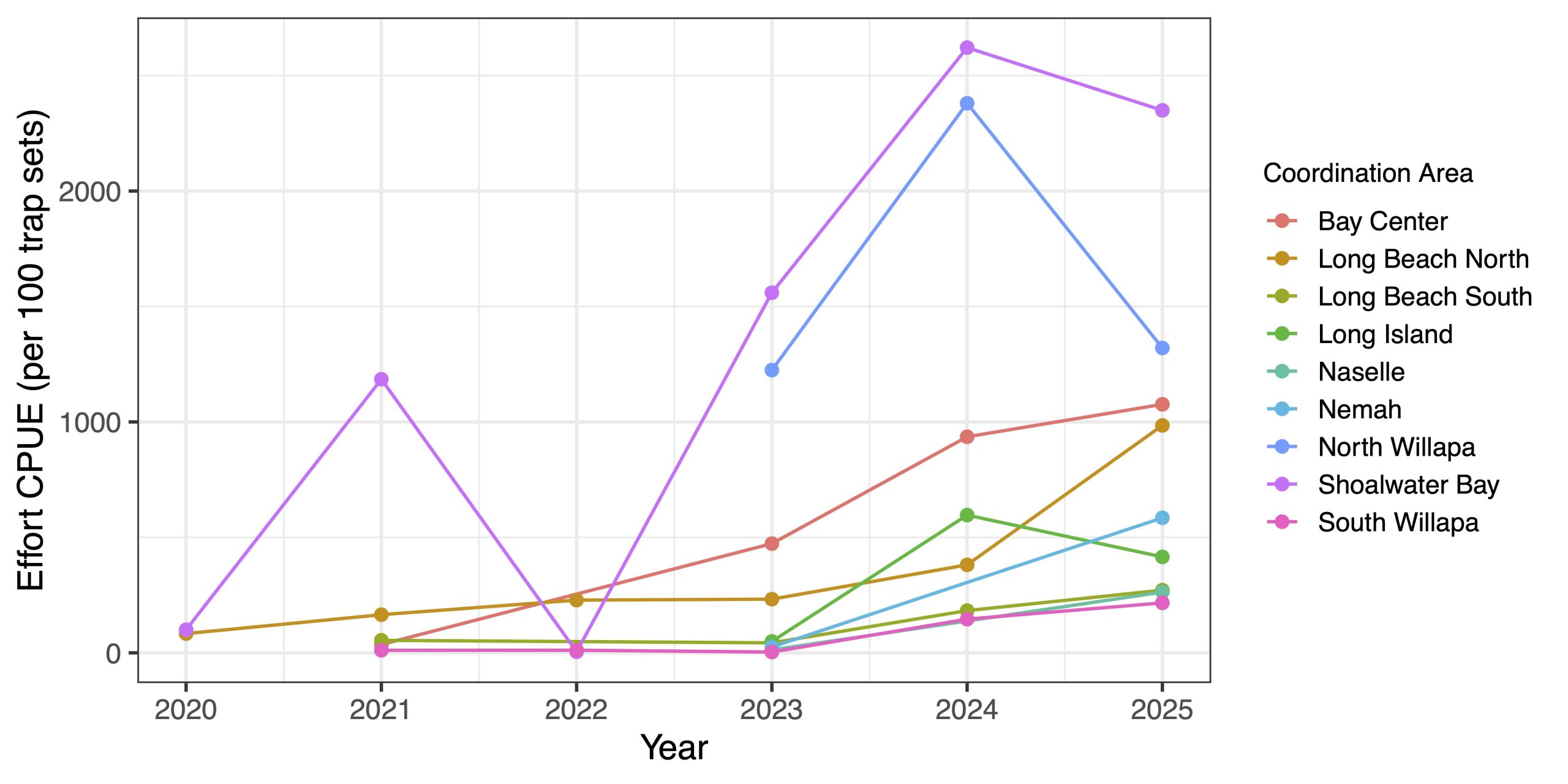
- Green crabs were found at nearly every site trapped in Willapa Bay in 2025, except for the farthest upriver site on the Naselle River at the south end of the bay.
- In parts of the bay where green crabs have been abundant for several years—especially in the north—catch rates were steady or slightly lower than in past seasons. Seasonally, green crab abundances increased greatly in most regions of the bay during the late fall.
- By contrast, at low abundance portions of the bay, particularly those in the south, catch rates continued to creep up in 2025, reducing the difference between the highest and lowest abundance regions.
- Greater numbers of young of the year were captured during the late season peak than the early season peak, particularly at sites closest to the ocean mouth. There was very little evidence of recruitment in traps during the possible early season peak (May/June)
- Shellfish growers reported higher catches in 2025, which may mean green crabs are spending more time in deeper areas where they overlap more with aquaculture operations.
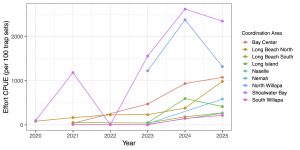
Average annual catch rate of green crabs at sites across Willapa Bay. Click to enlarge.
Grays Harbor
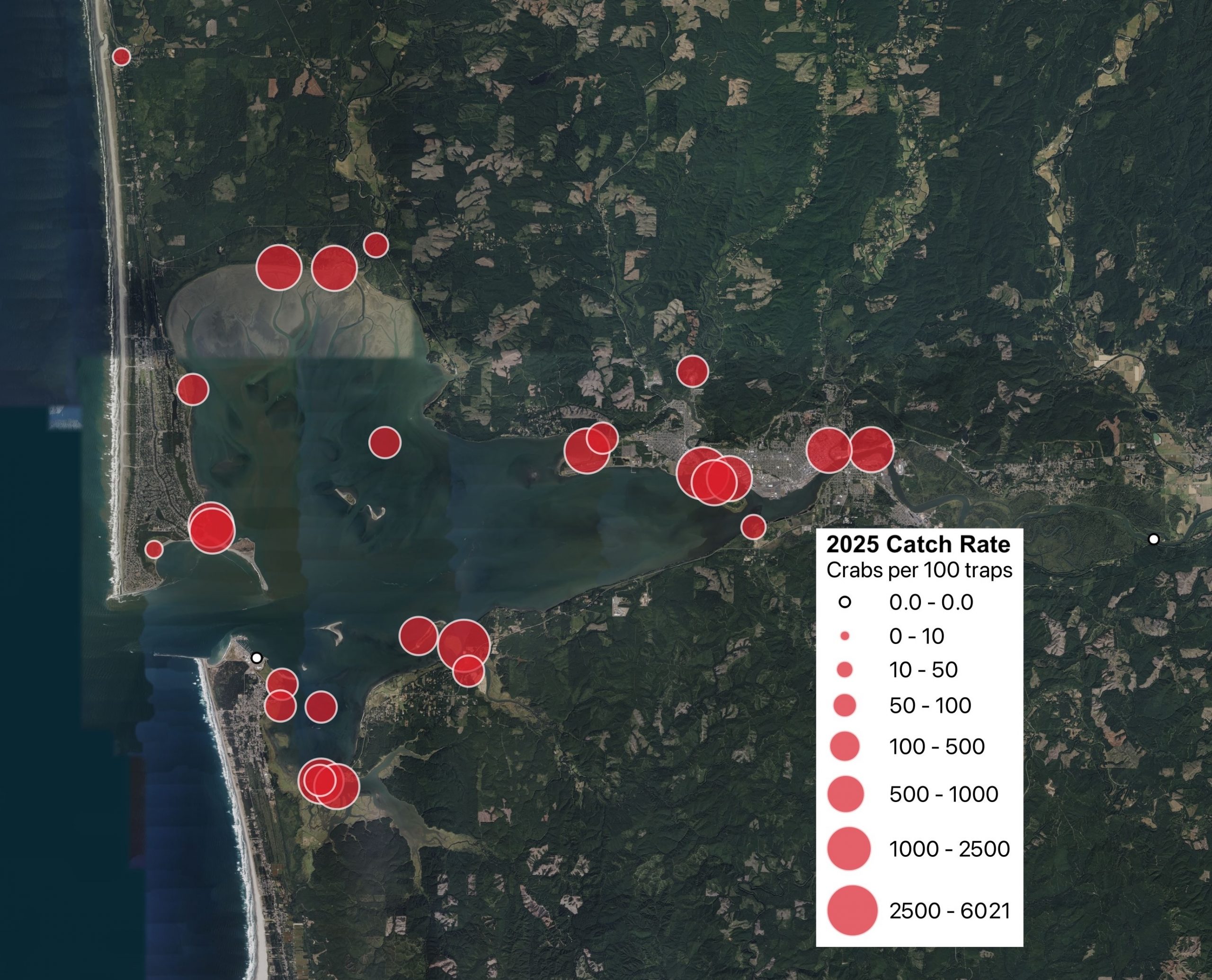
A zoomed in map showing green crab catch rate and trapping locations in Grays Harbor. Click to enlarge.
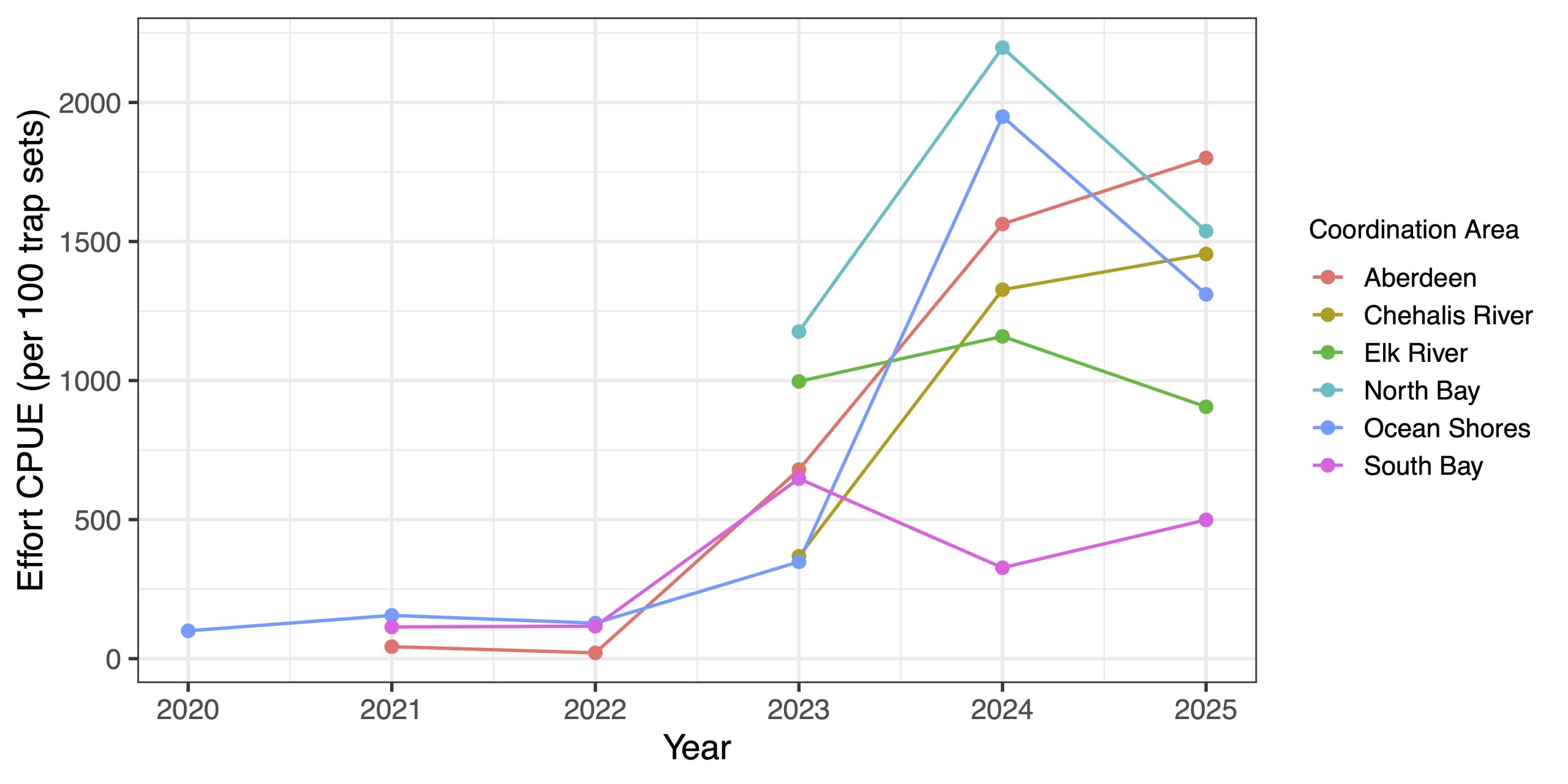
- In 2025, many regions of the bay experienced overall catch rates similar to the previous year, but some late season trapping could shift that pattern.
- As in Willapa Bay, trappers in Grays Harbor saw a seasonal pattern of increasing catch rates during fall months. They reported that the timing of that increase was earlier in 2025 than previous years.
- Also similar to Willapa Bay, green crabs are widespread across Grays Harbor. Only one site, far upriver on the Chehalis, had no green crabs trapped.
- Recruitment seemed evenly split between early and late season peaks.
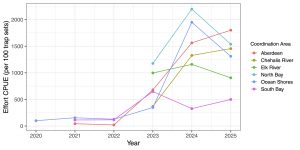
Average annual catch rate of green crabs at sites across Grays Harbor. Click to enlarge.
North Coast
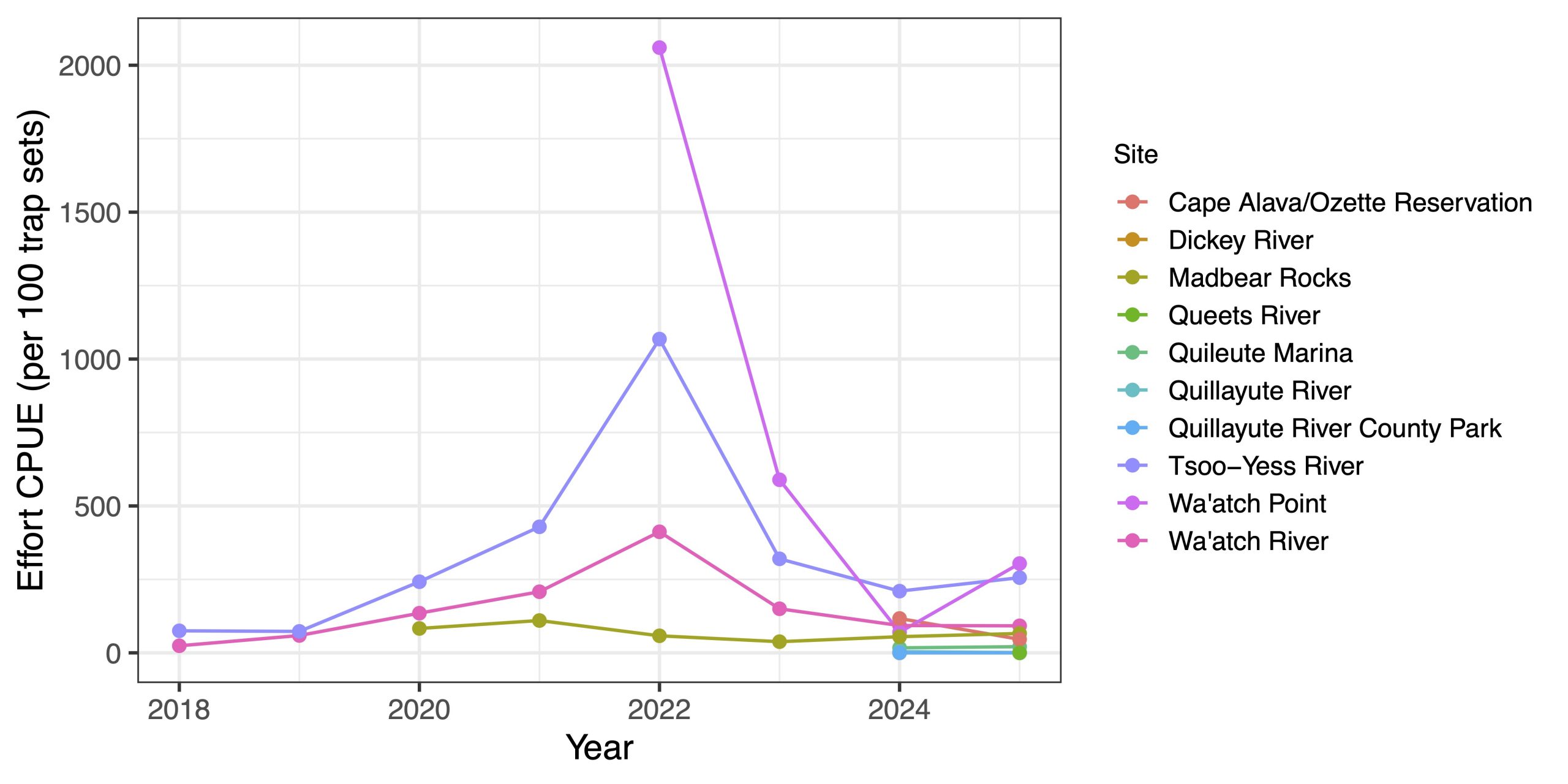
- In Makah Bay, the Makah Fisheries Department continued a strong trapping program. Catch rates at key sites were similar to last year and stayed well below the highest rates seen in 2022. Most new young crabs appeared in the spring, with very few showing up after July.
- For the second year in a row, the Makah Tribe also trapped at Cape Alava, a relatively wave-exposed rocky shoreline for green crab. While overall catch rates were low, repeated detections there are noteworthy because green crabs typically struggle to survive in such exposed habitats. Nearly all crabs caught were larger than 60mm, suggesting that small crabs do not survive well, and only a small number are able to persist long-term in these conditions.
- At Quileute marina, where green crabs were first detected in 2024, WDFW and Quileute Natural Resources staff found several crabs that had survived the winter during spring trapping in 2025, along with a smaller number of new young crabs later in the summer.
Average annual catch rate of green crabs at sites across the north coast management area. Click to enlarge.
Insight, Gratitude and Looking Ahead
Green crabs remain widespread along Washington’s Pacific coast, especially in large estuaries. While there are some hopeful signs such as a slowing or stabilization of population growth, other observations indicate that green crabs continue to expand their footprint, spreading to new habitats and slightly deeper bottoms. With each additional year of trapping, and longer trapping seasons, we learn more about the timing of green crab activities, such as growth and reproduction.
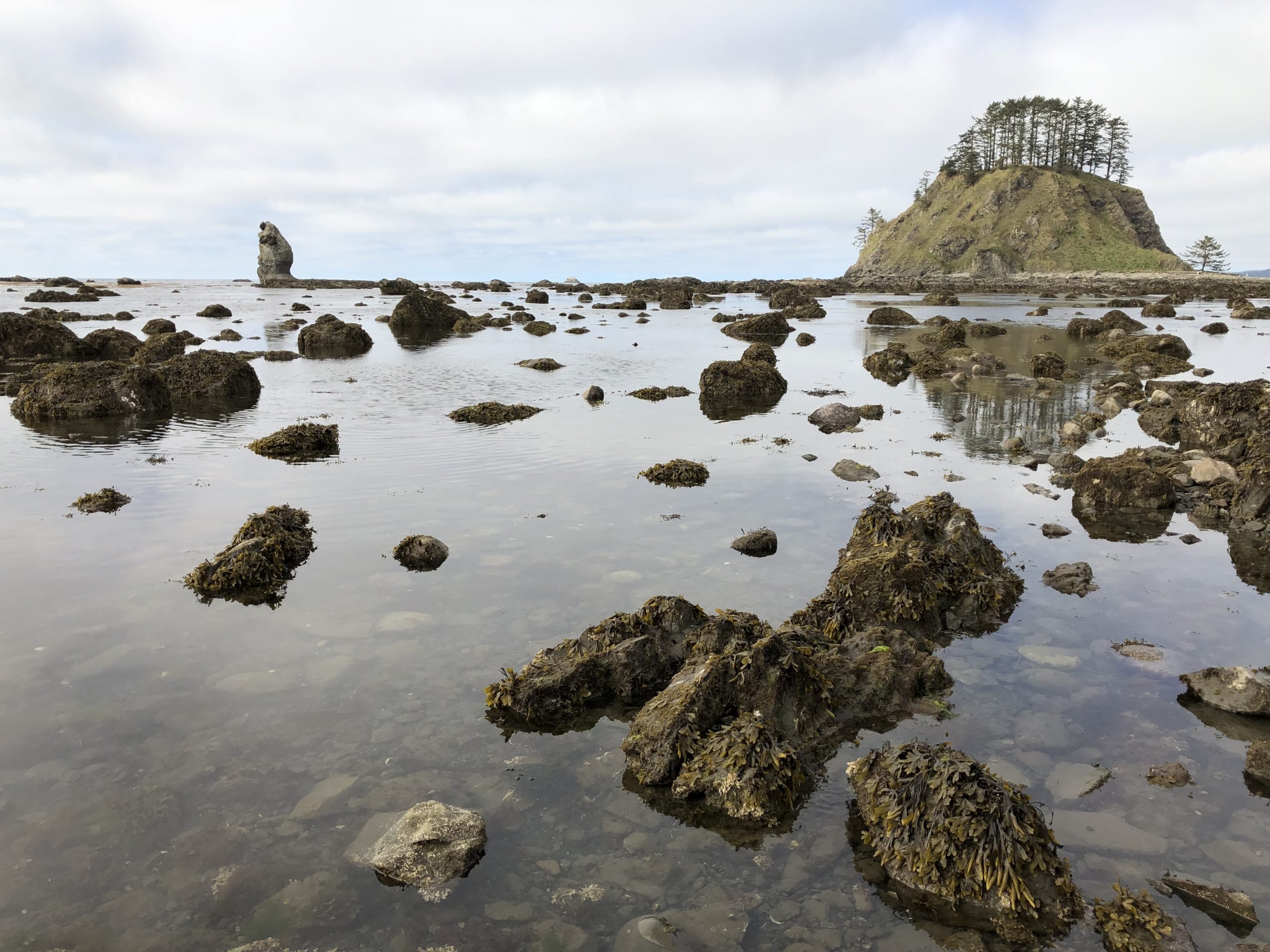
The open rocky bench habitat of Cape Alava, where green crabs have been trapped by Makah for the past two years.
Adding to our learning efforts, the ten Crab Team monitoring sites in this coastal geography offer a complement to partner data. Many of these sites have been monitored consistently over the past five years, enabling us to track site-level trends as well as capture some of the same larger scale phenomena. You can read a summary of 2025 Coastal Crab Team site observations on our Reports page.
We’re grateful to the people and groups who contributed not only to the muddy days trapping crabs, but also to helping make collective sense of all of our observations through data stewardship, sharing, and discussion. Invasions like this one can change rapidly, and progress in unexpected ways. In order to stay nimble, and separate the patterns from the “noise” in the data, we will continue to talk across geographies and positions. The community of trapping professionals is a resource we in Washington are all lucky to have!
This information would not be available without the contributions of coastal trapping partners, including: Shoalwater Bay Indian Tribe, Pacific County Conservation District, Pacific County Invasive Species Management, Willapa Bay Grays Harbor Oyster Growers Association, Washington Department of Fish and Wildlife, US Fish and Wildlife Service (Willapa NWR, Grays Harbor NWR), Makah Fisheries, Quinault Indian Nation, Quileute Tribe, Grays Harbor Conservation District, Pacific Seafoods, Washington Department of Natural Resources, Coastal Interpretive Center, numerous individual shellfish growers, and monitors with WSG Crab Team.
For additional information, visit the WDFW Green Crab Hub
–Emily Grason
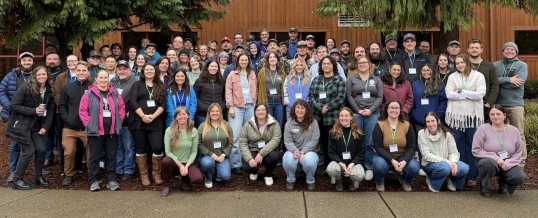
Header image: 71 trappers from 26 partner organizations across Washington Shorelines gathered in Shelton at Little Creek Casino Resort in December 2025 for the annual Trappers’ Summit. WSG hosts this workshop each year to enable technical staff to collectively discuss findings from the year and needs moving forward. Photo: K. Litle/WSG
JAN
2026