April 23, 2026
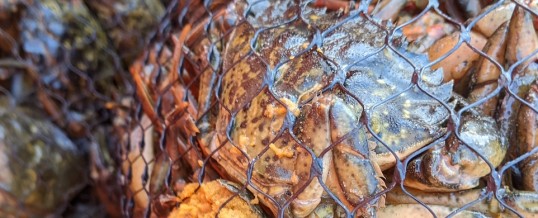
 Shellfish growers have long been stewards of Washington’s rich marine waters. After all, the industry as a whole relies on healthy marine ecosystems. So it probably comes as no surprise that shellfish growers have been partners in efforts to control invasive European green crab from the get-go. It has been routinely observed that green crab aggregate around aquaculture gear, particularly during colder months. Recently (March 2026) growers working around the Port of Nahcotta in Willapa Bay observed elevated numbers of egg-bearing (ovigerous) females sheltering inside PVC pipes laying flat on intertidal mudflats. This has raised interest in using pipes to aggregate and facilitate efficiently removing these crabs.
The Nahcotta observations align with research on habitat selection of brooding females done in California in 2001-2003, and a long history of ‘crab-tiling’ in southwest UK, where artificial structures are used to aggregate crabs for bait fisheries. Together, these lines of evidence highlight the strong affinity of green crab for structure and provide a clear rationale for tiling as a removal tool. But is the technique a silver bullet? Probably not.
Cautions and Caveats
There are several cautions and caveats that require careful consideration of when, where, and how any added structure is used in green crab control efforts.
Important Risk: Habitat Enhancement
Evidence from UK estuaries (see below for more detail) shows that tiling without sufficient removal can increase green crab abundance by adding refuge and reducing predation. This can lead to a positive feedback loop where increasing green crab habitat supports population growth.
Important Risk: Ecosystem Damage
Similar studies from the UK show that tiled sites have lower diversity of benthic invertebrates, and that shorebirds behave differently at these sites, in part because of the disturbance of human activity at the sites.
Nevertheless, the approach is another tool to our toolbox, particularly when used prudently to maximize efficacy and avoid unintended consequences (see more below).
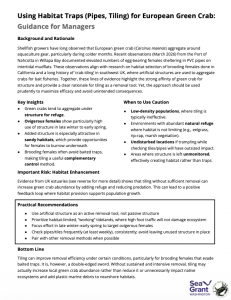
To support green crab trappers around the state, WSG Crab Team has produced a printable 1-page summary document on the topic, as well as the following practical recommendations based on this science for groups with green crab permits to reduce the chance for unintended consequences:
- Use artificial structure as an active removal tool, not passive structure
- Prioritize habitat-limited, “working” tidelands, where high foot traffic will not further damage ecosystem
- Focus effort in late winter–early spring to target ovigerous females
- Check pipes/tiles frequently (at least weekly) and consistently; avoid leaving unused structure in place
- Pair with other removal methods when possible
Case Study: Tiling in the UK
A Cautionary Tale of Unintended Consequences
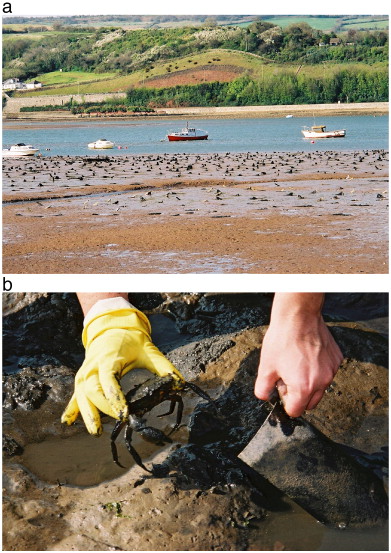
Figure 1 from Sheehan et al. 2008 showing photographs of tiling activity in southwest UK. Click to enlarge.
Efforts to use habitat traps (or tiling) in Washington State might be informed by experience elsewhere. There is in fact a long history of “crab-tiling” in estuaries of the southwest United Kingdom, where the practice has been used commercially for at least three decades, not only to aggregate green crabs but to increase their populations by protecting them from predators. Bait collectors (“crab-tilers”) place hard structures such as roof tiles, half-round guttering, and other materials on intertidal mudflats to create shelter that green crab burrow beneath. This fishery removes over 1 million green crabs annually, though only about 10% of crabs found under tiles are retained (typically larger, pre-molt individuals suitable for bait). Tens of thousands of tiles (estimated ~77,000) are deployed across estuaries, demonstrating the strong and predictable aggregation response of green crab to added structure (Sheehan et al. 2008).
At the same time, this history highlights an important management tension: tiling is effective at concentrating crabs, but it also represents large-scale habitat addition in otherwise structure-limited environments. The ecological consequences of this added habitat, particularly when not paired with intensive removal, remain a central concern. Known impacts in the UK involve decreased diversity and abundance of native benthic invertebrates due to habitat disturbance (i.e., trampling of tideflats, Sheehan et al. 2010) and modified behavior of shorebirds in tiled environments (Sheehan et al. 2012).
Research by Sheehan et al. (2008) suggests that tiling could unintentionally increase green crab abundance when it is not paired with sufficiently intensive removal. Tiled systems in UK estuaries supported higher numbers of green crabs than non-tiled areas, likely because added structure reduced predation and improved survival. Populations in these areas also skewed toward smaller size classes, suggesting enhanced recruitment and retention, while overall abundance increased despite differences in the proportion of reproductively active individuals. Taken together, these findings highlight that tiling can create a positive feedback loop, where added habitat supports population growth unless removal efforts are strong enough to offset it.
Research cited:
- Sheehan, E. V., Thompson, R. C., Coleman, R. A., & Attrill, M. J. (2008). Positive feedback fishery: population consequences of ‘crab-tiling’on the green crab Carcinus maenas. Journal of Sea Research, 60(4), 303-309.
- Sheehan, E. V., Coleman, R. A., Thompson, R. C., & Attrill, M. J. (2010). Crab-tiling reduces the diversity of estuarine infauna. Marine Ecology Progress Series, 411, 137-148.
- Sheehan, E. V., Attrill, M. J., Thompson, R. C., & Coleman, R. A. (2012). Changes in shorebird behaviour and distribution associated with an intertidal crab fishery. Aquatic Conservation: Marine and Freshwater Ecosystems, 22(5), 683-694.
–P. Sean McDonald
APR
2026