May 4, 2026
Crab Team likes to shine a light on the creatures we encounter in our muddy environments, from the rare and far-out, to the common and familiar, each of the species in Washington estuaries plays a role in local ecology. They also have a story to tell when they appear in Crab Team monitoring traps. In September of 2025, two separate network monitoring sites in Grays Harbor both captured Pacific tomcod. A grand total of five fish of one of the most common species in our region caught our attention. Why? Because in the hundreds of thousands of traps set for green crab over the last 10 years, they had never been reported in the catch. So we decided to take a closer look.
Small cod, big role in Washington’s coastal estuaries
It’s hard not to feel a little bad for the Pacific tomcod (Microgadus proximus; MIPR). Being a “tomcod” is a bit like growing up as Nick Clooney, Doug Pitt, or Kyle Damon. You’ve got the name recognition, but none of the prestige. While many readers may not be familiar with tomcod, it’s hard to escape the influence of their more famous relative: the Atlantic cod. The Atlantic cod is known simply as cod because, like Elvis, it is the undisputed king and no one is confused by the mononym. According to Mark Kurlansky, author of Cod: A Biography of the Fish that Changed the World, Atlantic cod has shaped human history for over a thousand years.
But not the tomcod. Pacific tomcod are not large or flashy, and they rarely receive even the same attention as other local members of the extended Gadidae family, like Pacific cod (Gadus macrocephalus) or walleye pollock (notably, these two species account for more than 50% of current volume and value in US fisheries). Unlike those larger relatives, Pacific tomcod are small, typically reaching 20-30 cm (8-12 inches) in length. In fact, the name “tomcod” refers to their resemblance to juvenile cod (ouch – even the name is a sick burn). Despite the similar appearance, Pacific tomcod are a distinct species adapted to life in dynamic coastal environments.
Tomcod range extends along the Pacific coast of North America from California to Alaska, and they are commonly found in nearshore marine waters and estuaries. Although not targeted by commercial fisheries, they are a consistent (if often overlooked) component of coastal fish communities and occasionally show up in survey gear or as bycatch. They occur from the surf zone to depths of about 275 meters, though they are most common in shallow waters over soft-bottom habitats such as mud, sand, and silt. Tomcod are often associated with mixing zones where freshwater and ocean water meet, as well as areas of strong tidal exchange where food is concentrated.
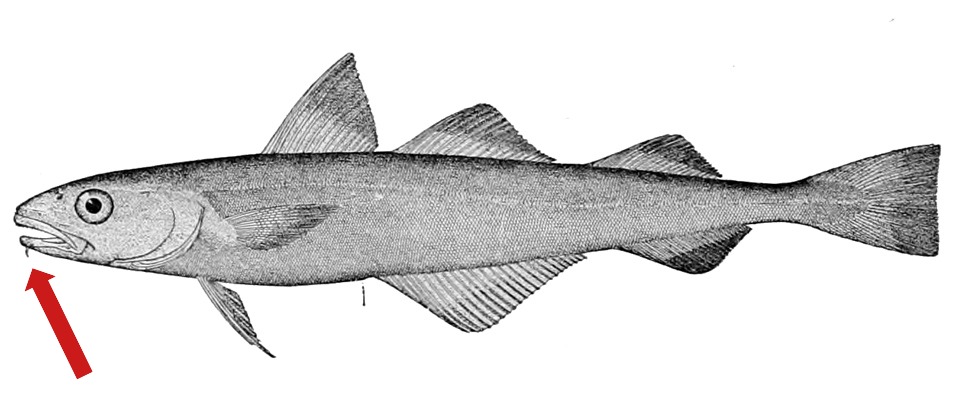
Illustration of a Pacific tomcod with a red arrow pointing to the characteristic chin barbel. Click to enlarge. Photo: Microgadus proximus (Girard). [https://archive.org/details/bulletinofunited261906unit/page/348/mode/2up] by United States Bureau of Fisheries, 1904. Public Domain.
A family resemblance
At first glance, Pacific tomcod look like a “mini-me” version of a cod or pollock. They have a slender body with three dorsal fins, typical of the family. Like many gadids, tomcod have a small chin barbel (a whisker-like sensory organ under the chin). They are a mottled brown or gray coloration that blends with sandy or muddy bottoms. They also possess large eyes relative to their body size. These features reflect a fish well adapted to living along the seafloor, where they search for prey.
One of the most reliable identification features for distinguishing tomcod from their local relatives is the chin barbel. Pacific tomcod have a very short barbel; to be precise, it is shorter than half the diameter of the eye. In contrast, Pacific cod have a much longer barbel, while walleye pollock lack one entirely.
The estuary connection
Although Pacific tomcod spawn in marine waters, estuaries play an important role in their life cycle. Like many coastal fish, tomcod shift habitats as they grow: larvae and small juveniles are pelagic, drifting in the water column, while older juveniles and adults are demersal, living near the bottom. Estuaries provide rich feeding opportunities, particularly for juveniles, where tides concentrate plankton and warmer temperatures promote primary production. The soft sediment habitat in these areas support dense communities of prey. In systems like Grays Harbor and Willapa Bay, on the outer coast of southwest Washington, the productivity of tidal flats and eelgrass beds fuels food webs that extend beyond the estuary itself. Species like Pacific tomcod are well positioned to take advantage of this constant flow of energy.
Pacific tomcod typically spawn during winter and early spring in marine waters along the coast. Their eggs are likely demersal and adhesive (like some other gadids), sticking to the seafloor rather than drifting. After hatching, larvae enter the plankton before eventually settling as bottom-dwelling juveniles in or near estuaries. Juveniles tend to prefer shallower depths in the summer and fall, moving to deeper water as they mature into adults. This combination of pelagic early life stages and demersal (meaning staying close to or on the bottom) juvenile and adult phases is common among coastal fish and allows tomcod to take advantage of both offshore and estuarine environments. They are also relatively fast-growing and short-lived, reaching adulthood within their first or second year of life.
Do you even cod, bro?
Despite their small size and lack of commercial value, Pacific tomcod, like their kin, play key ecological roles. By some estimates, they are nearly as abundant as staghorn sculpin and English sole in Washington’s coastal estuaries. Like these other species, they are opportunistic benthic predators that consume a wide variety of small animals, including amphipods, polychaete worms, small crabs, fish larvae and small bait fish like anchovies. The sand shrimp (Crangon species, SAND) may be a particularly important prey group for tomcod, which puts them in competition for food with other fish and even Dungeness crab.
In turn, Pacific tomcod are prey for marine mammals, birds and even larger fish. Several studies have highlighted tomcod in the diets of harbor seal populations in Washington State, although they make up a relatively small portion of the diet compared to dominant forage fishes like herring and sand lance. Previous work has also demonstrated that juvenile tomcod are a staple for common murres in coastal estuaries, along with northern anchovy. Even if they rarely dominate any single predator’s diet, Pacific tomcod play a consistent role in helping to sustain a wide range of predators and keep energy moving through coastal and estuarine food webs. Indeed, evidence suggests that small fish like tomcod are an important link in years when other forage fish are scarce.
A lot of hullabaloo over five fish
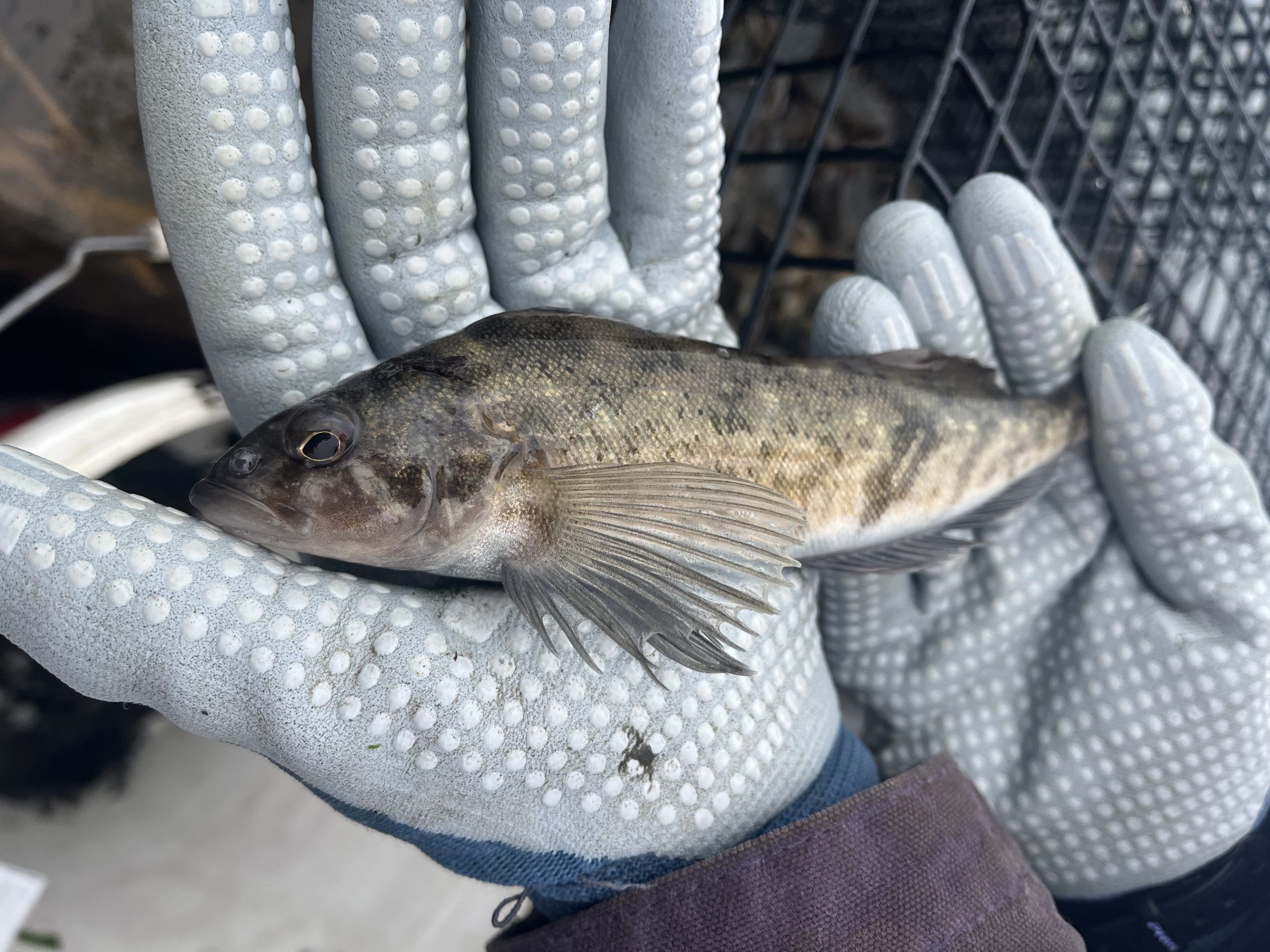
Pacific tomcod trapped in the Grays Harbor Conservation District in 2025. Click to enlarge. Photo: Grays Harbor Conservation District
When consistent monitoring like Crab Team finds a new critter, or a species only at one site, it can be an outlier, a lark, an observation out of left field that doesn’t tell us much about the broader environment. But when a surprising observation happens at multiple locations simultaneously, we start to pay attention and want to learn more. In addition to the two Crab Team sites in Grays Harbor that found tomcod, green crab trappers working in several areas across the bay also noticed this species in their traps this year. This could indicate 2025 had a “bumper crop” of tomcod in that estuary. To be sure, tomcod are abundant in Willapa Bay and Grays Harbor; previous research has shown how the species uses these areas. What’s more interesting is where in the estuary we’re trapping them now. Only time (and continued observations) will tell if tomcod are becoming more abundant or more widespread. And that’s exactly the kind of thing Crab Team monitoring was designed to do!
–P. Sean McDonald
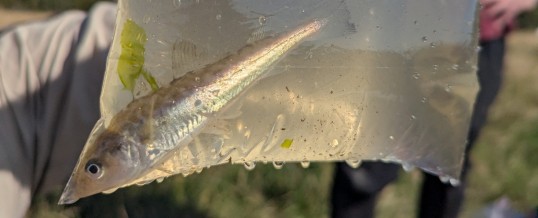
Header Photo: Pacific tomcod trapped in a green crab trap in Grays Harbor in 2025. Photo: Grays Harbor National Wildlife Refuge
MAY
2026