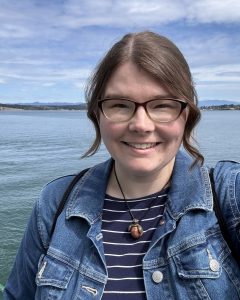
 My name is Emily Bjornsgard, and I am so excited to join Washington Sea Grant as the Spring/Summer Graduate Science Communications Fellow! I am currently pursuing a master’s degree at Western Washington University, where I am examining the effects of diatom-derived polyunsaturated aldehydes (chemical compounds) on the survival and feeding abilities of larval forage fishes here in the Salish Sea. I am an (almost) lifelong Washingtonian (with a brief stay on the Oregon Coast), and I love exploring and sharing the wonders of the Pacific Northwest. I grew up in rural, coastal southwest Washington, and first earned an associate of arts transfer degree at Grays Harbor College before finishing a bachelor’s degree at Western Washington University, majoring in biology (marine emphasis). Graduating into the early days of the COVID-19 pandemic, I moved to the Oregon Coast to complete a Certificate in Aquarium Science at Oregon Coast Community College in 2021.
Between 2021-2025, I worked in the aquarium and environmental education fields, caring for hundreds of Salish Sea species, raising baby fish, and creating volunteer and public learning opportunities about our shared waterways. While in Oregon, I worked as an Education Project Assistant in Hatfield Marine Science Center’s Visitor Center as a part of Oregon Sea Grant, and also volunteered in the aviculture department at the Oregon Coast Aquarium! Upon returning to Washington state, I was hired as the Aquarium Curator at WWU’s SEA Discovery Center in Poulsbo, where I worked for a year to restart the aquarium exhibits and brought in 50 local marine species to introduce to visitors and volunteers alike. Most recently, I worked at SEA Discovery Center’s partner facility, the Marine and Science Technology (MaST) Center in Des Moines, operated by Highline College. In addition to animal care and aquarium life support maintenance, I had the opportunity to raise Pacific Spiny Lumpsuckers (Eumicrotremus orbis, aka the world’s cutest fish) and Grunt Sculpin (Rhamphocottus richardsonii, the world’s second cutest fish), and taught “Phyla Training,” a hybrid, lecture-based public educational program about the marine biology and ecology of the Salish Sea. It was largely through developing this program that it became clear that my path forward focuses on teaching and sharing what I love with the world around me. This clarity is what drives me through my graduate studies and beyond.
I am thrilled to have been selected to work with the Washington Sea Grant Science Communications team, and look forward to learning and sharing more about the incredible research and environmental projects happening throughout Washington.
###
Washington Sea Grant, based at the University of Washington, helps people and marine life thrive through research, technical expertise and education supporting the responsible use and conservation of coastal ecosystems. Washington Sea Grant is one of 34 Sea Grant programs supported by the National Oceanic and Atmospheric Administration in coastal and Great Lakes states that encourage the wise stewardship of our marine resources through research, education, outreach and technology transfer.
Join the conversation: instagram.com/waseagrant and Facebook.com/WaSeaGrant.
MAY
2026