April 29, 2026
By Alison Lorenz, Communications Project Coordinator
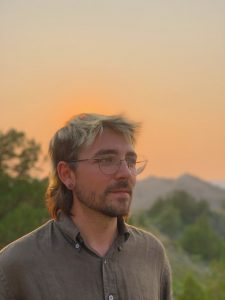
Rich Desanto
When Rich Desanto applied for the new Washington Sea Grant (WSG) Coastal Resilience Fellowship, he was looking for a change. After nine years in Seattle, mostly spent in grad school and weathering the COVID-19 pandemic, Desanto was feeling priced out of the city and unsettled in his career in landscape architecture. He was already subscribed to the Washington Sea Grant (WSG) Shorelines and Coastal Planners Group email listserv, and had a friend who’d completed a WSG Hershman fellowship. When she sent him the Coastal Resilience Fellowship—and he saw it pop up again in his inbox—he decided to go for it.
“I really put all my eggs in one basket in that moment,” Desanto laughs, describing his decision to accept the two-year, paid opportunity that had him pack up his life to move to Astoria, Oregon. “I just thought yeah, this makes sense, this is how I’ll pursue what’s most aligned.”
Desanto has since started work as a WSG Coastal Resilience Fellow in South Bend, Washington. His host organization, Pacific Conservation District (PCD), is serving as an intermediary between communities, consultants and agencies in addressing water management around the Grayland Plains drainage ditch. The ditch is essential to prevent flooding in Washington’s Pacific and Grays Harbor counties and helps to keep saltwater out of nearby cranberry farms, a key economic driver in the area. As changing water levels and aging infrastructure prompt a redesign of the drainage ditch, other community priorities–such as wildlife habitat conservation and protecting the area’s drinking water–can be brought into the fold. “I’m hoping to chase those elements of community connection, concern for the environment and the way it impacts and is impacted by people,” Desanto says.
Bringing Desanto onboard helped PCD to release the project’s Request for Qualifications in January 2026, officially moving it into the implementation phase. It’s just this type of on-the-ground capacity building that the Coastal Resilience Fellowship aims to provide, with an innovative offer to host organizations: not only are fellows strongly encouraged to relocate to better integrate into their hosts’ communities, but they also join their host organizations for two years free of charge. On the fellows’ side, the positions are well-compensated, allowing fellows to be supported while also attracting a wider pool of applicants.
“There’s a lot of need out there”
WSG’s Coastal Resilience Fellowship is funded by National Oceanic and Atmospheric Administration’s Climate Resilience Regional Challenge, a competitive grant program focused on increasing the resilience of coastal communities to extreme weather, sea level rise and other impacts of a changing environment. WSG’s coastal resilience and fellowship teams had talked for years about how best to support the rural communities on Washington’s Pacific coast as they pursue increased resilience. Based on deep knowledge and experience, conversations with partners, and learnings from projects and reports like the William D. Ruckelshaus Center’s Washington State Coast Resilience Assessment, a fellowship program seemed apt for helping these communities build local capacity.
“We know there’s a lot of need out there,” says Sydney Fishman, WSG coastal management specialist and an advisor in developing the program. “The Coastal Resilience Fellowship is very different from other programs. In addition to it being no cost, it’s a two-year program, so it creates more stability for the host. That continuity is important, because sometimes you can’t finish a project in one year.”
The unique nature of the fellowship is also due in part to Becky Bronstein, whom WSG hired to spearhead the development and stewardship of the program. With the support of a working group, she reached out to partners to create a program that conscientiously balances the experiences of fellows with the needs and expectations of their hosts. “The working group was an amazing opportunity to learn from other Sea Grant fellowship programs, Tribe and state agency partners, and fellow alumni,” Bronstein says. The working group met throughout the year to give members time to hear updates about the program and guide and advise its development based on their particular expertise and experiences.
“Fellowships provide a unique opportunity for a two-way exchange between hosts and fellows,” Bronstein says. “For the Coastal Resilience Fellowship, hosts receive meaningful contributions from a fellow through new capacity and a fresh perspective, while the fellow gets to build new relationships, receive customized professional development, and hopefully build the skills to set them up for a career in coastal resilience. We look for hosts and fellows that can carry out this exchange.” What Fishman calls the “overwhelming amount of interest,” both from potential hosts and fellowship applicants, “is testament both to the fact that there is a big need and also that the details of the program were working out for folks.”
Sanpisa Sritrairat, WSG community engagement specialist and another advisor for the Coastal Resilience Fellowship, notes that while a lot of fellowship programs depend on the host to lead everything, “With this fellowship, fellows stay connected with experts from WSG and partnering agencies. Fellows are introduced to a strong network of coastal resilience professionals and gain access to a wide range of resources, including professional development opportunities.”
As the network of skilled professionals who are well integrated with the local community grows, she says, “I’d hope it would broaden community-led coastal resilience work and increase long-term capacity in the area.”
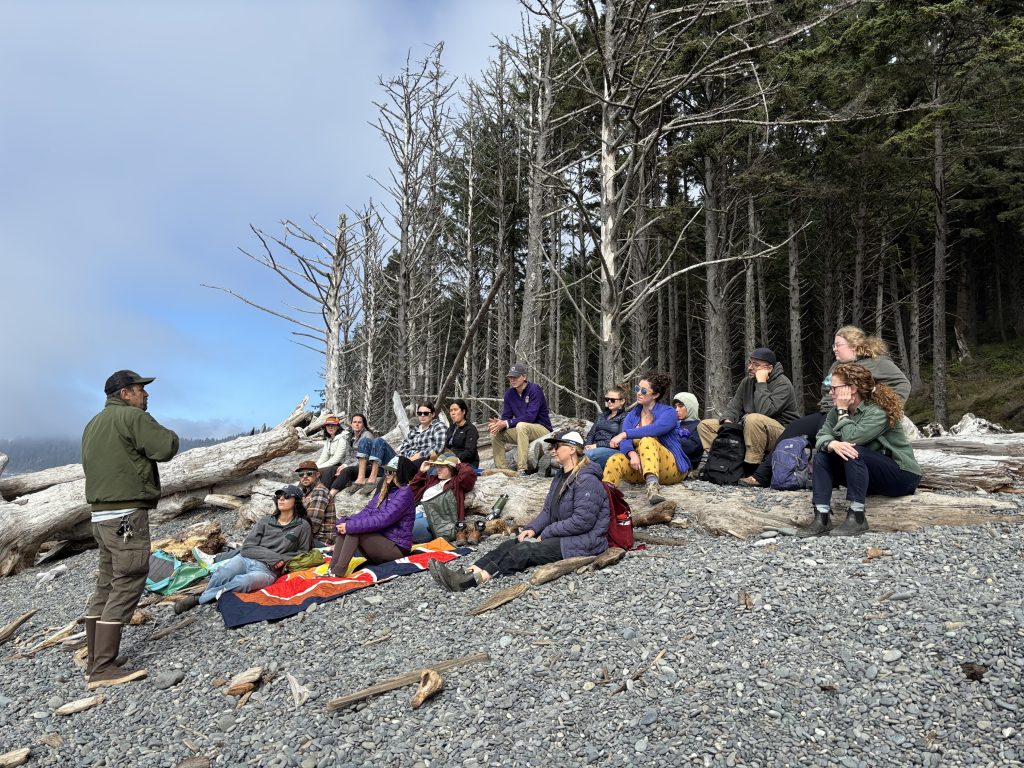
Before starting their positions, Coastal Resilience Fellows attended a summer learning institute emphasizing place-based learning. One outing to Rialto Beach was led by Dr. Steve Fradkin of the National Park Service. Photo by Katie Boyd
“It feels like my home”
For Coastal Resilience Fellow Maddy Lucas, her placement at Shoalwater Bay Indian Tribe has allowed her to imagine a career path outside of academia. As a PhD candidate in earth and space sciences at the University of Washington, Lucas has been working to understand earthquake and tsunami hazards in the Pacific Northwest in collaboration with the Cascadia Coastlines and Peoples Hazards Research Hub. Her fellowship has allowed her to directly apply her research. “My research is supposed to result in products that are useful to communities that are preparing [for coastal hazards],” Lucas explains. “I wanted to engage with communities, and I’m really enjoying it, getting to directly apply change.”
Shoalwater Bay Indian Tribe’s small staff means that, alongside her work improving tsunami evacuation routes for the Tribe, Lucas has already connected with a range of professionals outside her host planning department–and begun to build strong relationships in her field. “Helping Maddy with career development also helps us with mentoring and learning more about her expertise. She has an expertise that nobody else here has,” says Risa Thomas, planning director and community development coordinator at the Tribe.
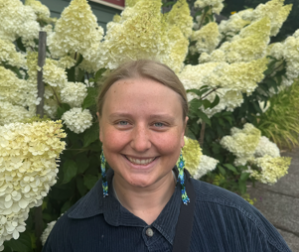
Maddy Lucas
Beyond the valuable professional experience and network-building is the personal relationships Lucas and the other fellows have already built. During our interview, Lucas’s colleagues repeatedly poked their heads in, curious if she would be joining them to play Dungeons and Dragons during lunch. “I can’t imagine what my life would be like if I hadn’t come here, and it’s only been two months,” Lucas says. “It feels like my home.”
Similarly, Desanto describes joining a local knitting group at the suggestion of Connie Allen, leader of Pacific County’s erosion mitigation group Wash Away No More. “That’s been the most delightful thing so far,” Desanto says, noting he gets to learn about knitting and how his project impacts local people at the same time. “As time progresses I will have those opportunities to connect with people human to human instead of government organization to community member.” Though Desanto and his cohort hoped to make a change in accepting their fellowships, working alongside local resilience leaders on the Pacific coast may be changing their lives more than they could have imagined.
###
Washington Sea Grant, based at the University of Washington, helps people and marine life thrive through research, technical expertise and education supporting the responsible use and conservation of coastal ecosystems. Washington Sea Grant is one of 34 Sea Grant programs supported by the National Oceanic and Atmospheric Administration in coastal and Great Lakes states that encourage the wise stewardship of our marine resources through research, education, outreach and technology transfer.
Join the conversation: instagram.com/waseagrant and Facebook.com/WaSeaGrant.
APR
2026