April 14, 2026
By Alison Lorenz, WSG Communications Project Coordinator
Almost ten years after the Washington State Coast Resilience Assessment pointed to a need for a unified, state-funded response to growing hazards on Washington’s coasts, the Coastal Hazards Organizational Resilience Team – or COHORT – is making its mark in coastal resilience by letting communities lead. The team recently published their first two-year report detailing their accomplishments.
The Coast Resilience Assessment kickstarted a chain reaction of projects to quickly grow the state’s capacity to prepare for coastal hazards. But a key point of the assessment’s recommendations was that state agencies couldn’t – and shouldn’t – tackle coastal hazards on their own. Follow-ups like the Washington Coastal Resilience Project (2016-2019) and the Resilience Action Demonstration Project (2019-2021) instead proved the concept of bringing state funds, expertise, and helping hands directly to communities and letting locals direct the process of building coastal resilience.
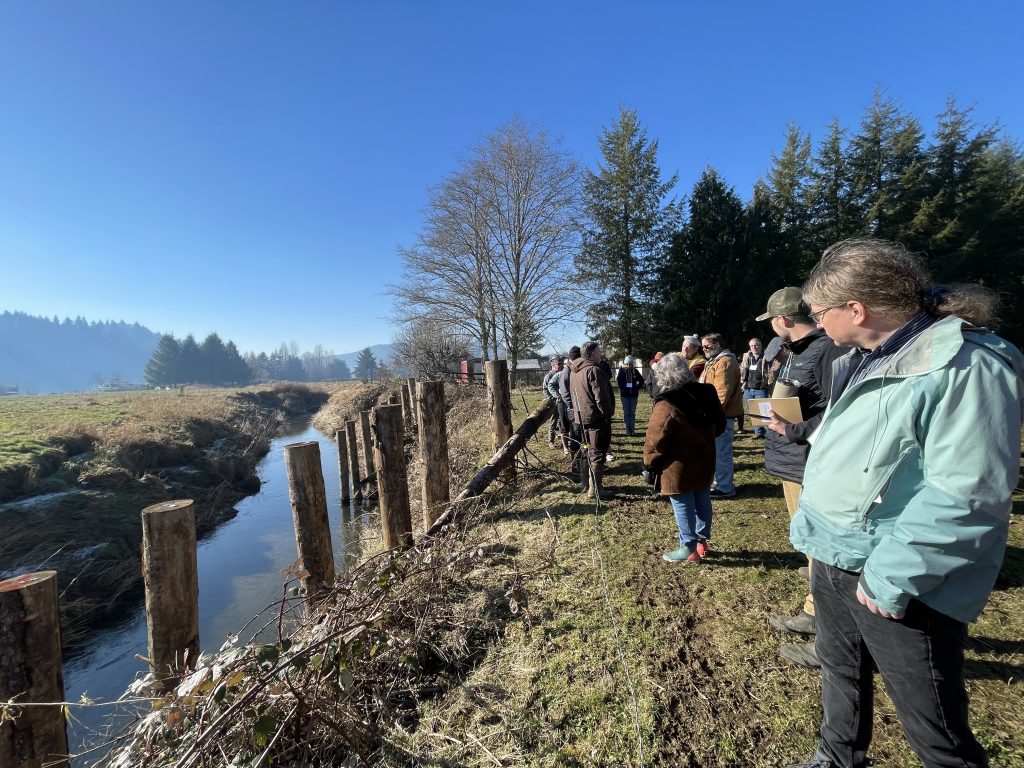
Participants in the Wahkiakum Common Ground workshops were shown local examples of successful watershed restoration projects.
Funding for the Washington State Department of Ecology from the Washington State Legislature supports four full-time COHORT staff: one at Washington State University Extension, Washington Emergency Management Division, Washington Department of Ecology, and Washington Sea Grant. This small but mighty team does just about everything, from characterizing the specific coastal hazards facing a community to scoping the projects that could help mitigate them; from bringing a community together to identify their priorities to helping write a grant proposal to protect those priorities.
Since the inception of COHORT, the group has conducted over 450 outreach and engagement events across all 15 of Washington’s coastal counties; supported more than 75 projects that address coastal hazards and advance community goals; and helped communities and Tribes secure over $86 million in federal funding for resilience projects and planning efforts. Beyond those numbers are the real people and communities coming together to safeguard what matters to them.
Lower Columbia “Bay to Bay” Resilience Strategy
COHORT works by supporting and augmenting local leadership for community-oriented resilience efforts. The Bay to Bay project in the Lower Columbia River Estuary was one of the first to demonstrate the value of this ground-up approach to building coastal resilience. Running from 2021 to 2024, the project was led by Pacific Conservation District, the Lower Columbia Estuary Partnership, and Washington Sea Grant and created a roadmap for future community-led coastal resilience planning efforts. After initial outreach helped project partners better understand the local historical context and priorities in Baker Bay and Grays Bay, community members came together in a series of eight workshops, with four centered around each bay. COHORT team members helped to facilitate each workshop, first inviting participants to share the concerns, assets, questions, and collaborators most important to them.
“The uniqueness of COHORT is that we’re really on the ground, supporting the community in the ways that they’re prioritizing,” says Sanpisa Sritrairat, WSG community engagement specialist and a core member of the COHORT team.
The second and third workshops homed in on actions the communities could take to address the issues they saw, began scoping specific projects, and identified ways these projects could continue to be moved forward. Of the 12 projects put forward for advancement, seven have now either been funded or continue to receive COHORT support, including the Wahkiakum Common Ground project described in this article. But COHORT’s inter-agency nature means that projects can sprout outside the scope of the specific community workshops as well. For example, during the Bay to Bay workshops, the idea of a tsunami Vertical Evacuation Structure in Long Beach took hold; after COHORT connected the relevant parties to Emergency Management Division staff, the project was developed into a proposal for a Federal Emergency Management Agency grant.
Wahkiakum Common Ground
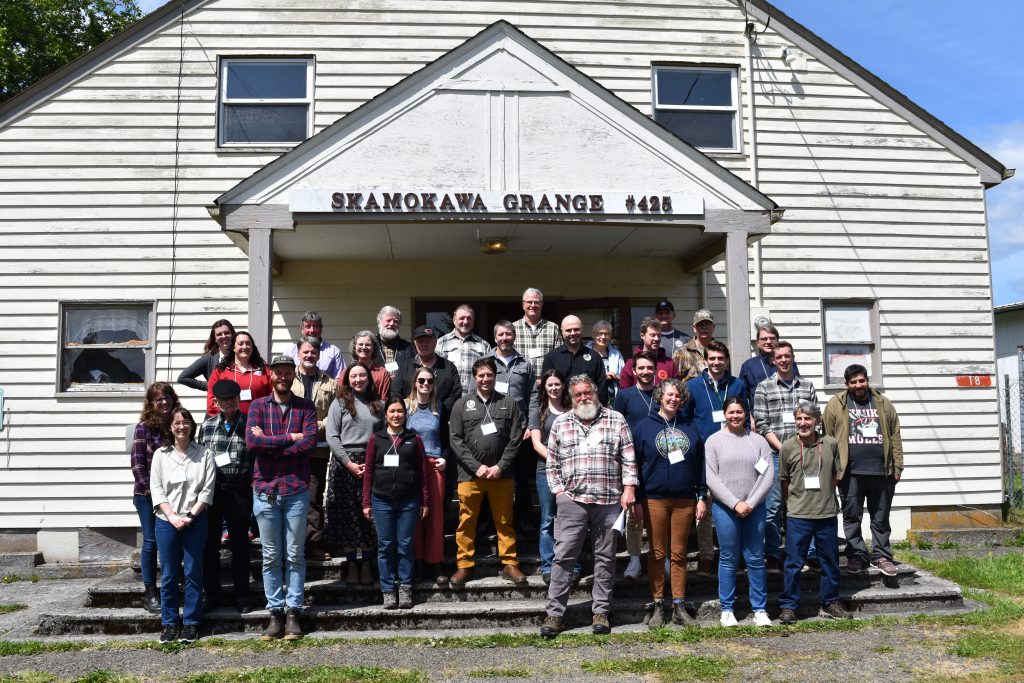
Participants in the Wahkiakum Common Ground workshop series. Photo by Andrea Mah
Wahkiakum County, in Washington’s southwest corner, is one of the state’s least populated and most rural counties, and regularly experiences severe high-water events and erosion. Recurrent flooding has damaged homes, roads, and businesses, as well as impacted salmon runs crucial to the area’s economy.
Co-leads of the county’s Marine Resources Committee (MRC), Sandra Staples-Bortner, Carrie Shofner (WSU Extension) and Sam Shogren worked with COHORT to plan a series of workshops aimed at helping their community work better together to address flooding hazards. The workshops didn’t dwell on mistakes of the past, but focused on introducing community members to local, successful watershed restoration projects. Attendees heard presentations, visited project sites, and then came back together to build connections and discuss the benefits of restoration work for people, salmon, and the local economy. The workshops convened leaders, both formal and informal, from all sectors: private landowners, community groups, county and tribal governments, nonprofits, local businesses, and state agencies.
COHORT team members supported the MRC in planning, structuring, and setting up the workshops. “They would come help us set out tables, make sure we had lunch out,” Shofner says. “They were rolling up their sleeves along with us.” COHORT members also attended the workshops to provide community members technical and subject matter expertise that wasn’t necessarily tied to a regulatory agency. Finally, they connected the MRC with Andrea Mah, a social scientist at Oregon State University who documented the mutual trust the workshops grew and helped to lay the groundwork for more amiable, effective and collaborative projects in the community going forward.
Staples-Bortner, Shofner and Shogren soon saw the benefits of the positive, apolitical space the workshops provided. Local experts in hydrology, landscape ecology, and fish biology were able to explain how the projects benefit local property owners and fish, while agencies, as Staples-Bortner put it, “were seeing who people really are.” As community priorities around both watershed restoration and local economic development coalesce, she says, “we, hopefully, can recognize agencies more as one of us.”
The MRC leads are optimistic about what comes next in Wahkiakum County. “COHORT provided resources we didn’t have in the county to have these conversations,” Shogren says. “They provided the expertise to think about and structure these workshops and enrich the conversations and our own thinking about what we wanted to do. COHORT was the door we could walk through to other resources.”
Shoalwater Bay Indian Tribe
Shoalwater Bay Indian Tribe’s Tsunami Vertical Evacuation Tower
For Risa Thomas, planning director and community development coordinator of the Shoalwater Bay Indian Tribe, COHORT has been supportive in a variety of ways. They helped support the first Winter Storm Forum, bringing together groups and communities from all 15 coastal counties to network and share knowledge and resources around storm-driven coastal flooding. Another gathering, NOAA Adaptation for Coastal Communities, was hosted by the Tribe, and convened partners from up and down the Pacific coast to talk planning, grant-matching, proposal development, and how to frame local issues and projects in terms decision makers understand.
“With COHORT, my hope is that we continue to build on the relationships we have,” Thomas says. The recent launch of WSG’s Coastal Resilience Fellowship, which she helped WSG to develop, was a further strengthening of Washington’s growing network of coastal resilience practitioners. Shoalwater Bay Indian Tribe welcomed their own Coastal Resilience Fellow, tsunami and geohazard-expert Maddy Lucas, in September, and Lucas was able to attend both the Winter Storm Forum and the NOAA event. “We are helping Maddy, but she’s also educating us on the work she’s done in the past, so it feels so natural,” Thomas notes. “I can’t see her not being here.”
As far as the Tribe’s work in coastal resilience and relocating their community, Thomas explains that it can be difficult to find help that is genuinely helpful. “There’s maybe ten of us relocating an entire village,” she says. “COHORT are so respectful of our time and really show up on how they can help us instead of the other way around. They’re helpful in a real way.”
Building connections and resilience
COHORT’s unique model of bringing technical expertise, facilitation experience, and additional capacity directly to the communities who need them has had great success. The group plays an essential role in supporting locally led resilience efforts, tailoring their offerings to the needs of each specific community. The help can look like anything from helping write a grant to analyzing sea level rise or coastal flooding vulnerabilities – to setting out sandwiches during a community workshop.
“This is really a program that needs to continue to see funding and needs to be sustained,” says Shogren. “Bringing expertise into small rural counties, being able to have the funding to hold these conversations, and having local voices treated with equal weight breaks down barriers to cooperation and understanding. It makes working with the state agencies a lot easier, and helps local people understand the concerns and perspectives of state agency folks. COHORT helps build bottom-up solutions to coastal hazards built on local community values, needs and concerns. It makes the government feel like it’s not so far away.”
###
Washington Sea Grant, based at the University of Washington, helps people and marine life thrive through research, technical expertise and education supporting the responsible use and conservation of coastal ecosystems. Washington Sea Grant is one of 34 Sea Grant programs supported by the National Oceanic and Atmospheric Administration in coastal and Great Lakes states that encourage the wise stewardship of our marine resources through research, education, outreach and technology transfer.
Join the conversation: instagram.com/waseagrant and Facebook.com/WaSeaGrant.
APR
2026