2025 Washington Coast Green Crab Summary

January 26, 2026

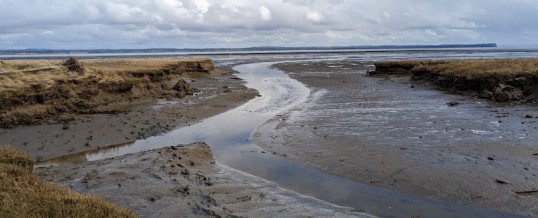
Washington’s Pacific coast has a different European green crab history than the Salish Sea and faces different conditions, so here we share a summary of 2025 green crab status and trends focused on sites within coastal estuaries. This summary is based on data collected by all trapping groups working in this geography (see the footer for a list). 

Where they are found in Washington green crabs are roughly 10 times more abundant at ...

Read More
0
2025 Salish Sea Green Crab Summary

January 5, 2026


Last year continued Washington’s trend of increasing green crab activity, both in the number of crabs trapped and in the growing network of people working to find and remove them. In early December, Washington Sea Grant (WSG) brought together trappers from across the state to compare notes from the 2025 season – our biggest Trappers’ Summit to date! We’re sharing highlights from those conversations in two annual summary posts. This post focuses on ...

Read More
0
Student Makes First Detection of Green Crab in False Bay, San Juan Island

June 9, 2025

Students at the University of Washington Friday Harbor Labs (FHL) found a green crab molt in False Bay on San Juan Island last weekend. This molt is the first evidence of green crabs found in False Bay and the first evidence since 2019 of green crabs in the San Juan Islands. In 2016, San Juan Island was the site of the first green crab confirmed along the Salish Sea ...

Read More
0
Sunsetting the Transect Survey 🌇

April 1, 2025

Today is the first day of the 2025 monitoring season and the Crab Team monitoring network is undergoing one of our biggest changes of the last decade. It is with very considered deliberation, discussion, and debate that we have decided to sunset the shoreline transect survey, one of the three sampling protocols that has been a part of the routine at Salish Sea Crab Team sites for nearly a decade.

Read More

0
Crab Team Turns 10: Crabstock Shell-ebration

February 26, 2025

Crab Team Origins & 10 Years of Accomplishments

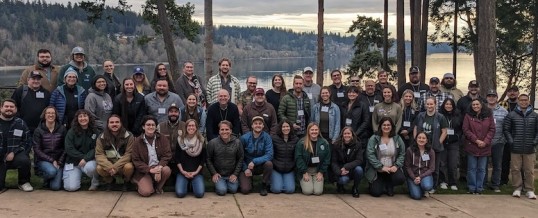
From humble beginnings spent daydreaming in 2014, from the first trap in the water in 2015, to a network of 307 active monitors across 68 sites: in 2024, Crab Team celebrated a decade of trudging around in the mud and counting crabs! A ...

Read More
0
2024 Green Crab Status Summary: Part 2 (Coastal Estuaries)

February 13, 2025

In this post, we’ll continue our reflections back on 2024 through the lens of the status and trends of European green crabs in Washington. In the last post, we shared observations from trapping efforts across Salish Sea shorelines. Here we shift to shorelines on Washington’s Pacific coast. 

The Coast in Context

As of writing this post, the total number of individual green crabs removed from Washington ...

Read More
0
2024 Green Crab Status Summary: Part 1 (Inland)

January 6, 2025


It’s a season of new beginnings, and as we transition into the New Year, we continue to wrap up what 2024 meant in terms of the European green crab invasion in Washington. And as WSG Crab Team wraps up the 10th year of green crab monitoring, we also find ourselves reflecting on the last decade. In the next few blog posts, we aim to share some of these summaries and reflections. We will ...

Read More
0
Protocol in Focus: Catches in Focus

December 16th, 2024

Tips for taking the best photos of your bin catches

Your bin photos may feel as easy as the click of a button, but they are the essential step in the protocol that allows the Crab Team dataset to be used by researchers. Namely, they are the tool for validating all your findings in our data QC process. As data submitters know, Crab Team staff (Emily!) cross checks every single trapping sheet and photo from ...

Read More
0
Protocol in Focus: Why do we measure native crabs, too?

June 18, 2024

Why Measure Native Species?

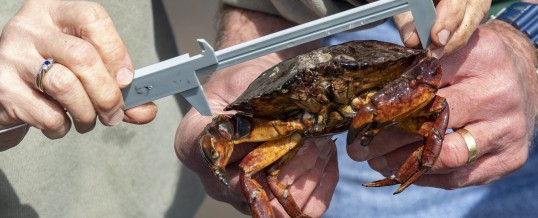
When it comes to interactions between crabs, whether of the same species or of differing species, size matters. When crabs run into each other out on tide flats, in lagoons, or channels, they might compete for food or shelter, or they may actually try to prey on each other. In these encounters, the general rule of #CrabLife is that bigger crabs win over smaller crabs. So knowing the size of not only green ...

Read More
0
2023 Green Crab Status Summary: Part 2 (Coast)

May 7, 2024

Continuing our summary of 2023 green crab status and trends 

Pacific Coast

The momentum and dedication to extensive trapping for European green crab on Washington’s Pacific coastline continued to grow through 2023. Over the course of the year, nearly 355,000 green crabs were removed from the coastal estuaries and shorelines. Let’s take a closer look at what the catch data showed about population status and trends.

Newer sites with high abundances

Read More

0
2023 Green Crab Status Summary: Part 1 (Inland)

April 10, 2024

While 2023 already seems like an eon ago, last year’s trapping season is still very much on our minds even as we launch the 2024 monitoring effort. The winter is a time for green crab managers to regroup, review data to interpret green crab population patterns and think about strategies for the coming year. In December, WSG hosted our third annual Trapper’s Summit, a day-long workshop for trapping partners all over the state to come and ...

Read More
0
Protocol in Focus: Why do we measure European green crabs?

November 17, 2023

We are Crab Team after all, so it’s perhaps no surprise that we are not shy about getting up to our elbows in details about the crabs we catch. But what can we actually learn from looking at size data of crabs? What makes handling all the angry pinchers worthwhile? 

We’re covering this rich topic in two issues of Protocol in Focus. This time, we’ll shed light on what we can ...

Read More
0
Environmental DNA (Part 4): The Vashon Island Mystery

September 26, 2022

This is the fourth and final in a series of posts on a Crab Team project to develop environmental DNA (eDNA) for use in early detection and management of European green crab. Links to the previous posts are found in the text below.

Environmental DNA (eDNA) has recently gained attention as a potential early detection and monitoring tool for green crab, thanks in part to work done by Abby Keller ...

Read More
0
Page 1 of 7 12345...»